MLR Review Metrics That Signal Process Breakdown
FDA enforcement letters in 2025 signal urgent need to catch MLR process failures early.

MLR review metrics matter because they tell you where a review process is failing before that failure turns into a warning letter. FDA issued more than 200 enforcement letters challenging pharmaceutical advertising and promotion in 2025, the highest annual count in nearly 25 years, with 74 of those aimed squarely at drug and biologic manufacturers and more than 100 landing in September alone from the Office of Prescription Drug Promotion. Layer on the long tail of financial risk (healthcare fraud settlements under the False Claims Act have topped tens of billions of dollars since 1986) and a slow or dysfunctional Medical, Legal, Regulatory review process becomes a liability generator that compounds quietly until it doesn't.
The timing is bad. Promotional content production rose 7% globally in 2023 and 29% in the U.S., and nothing suggests that pace has slowed. Meanwhile, hiring freezes and trimmed budgets in 2025 mean fewer reviewers are asked to move more material through the same pipe, under sharper regulatory scrutiny than the industry has seen in a generation. Something has to give, and metrics are how you find out what, before the FDA finds out for you.
What MLR cycle time actually measures — and what it hides
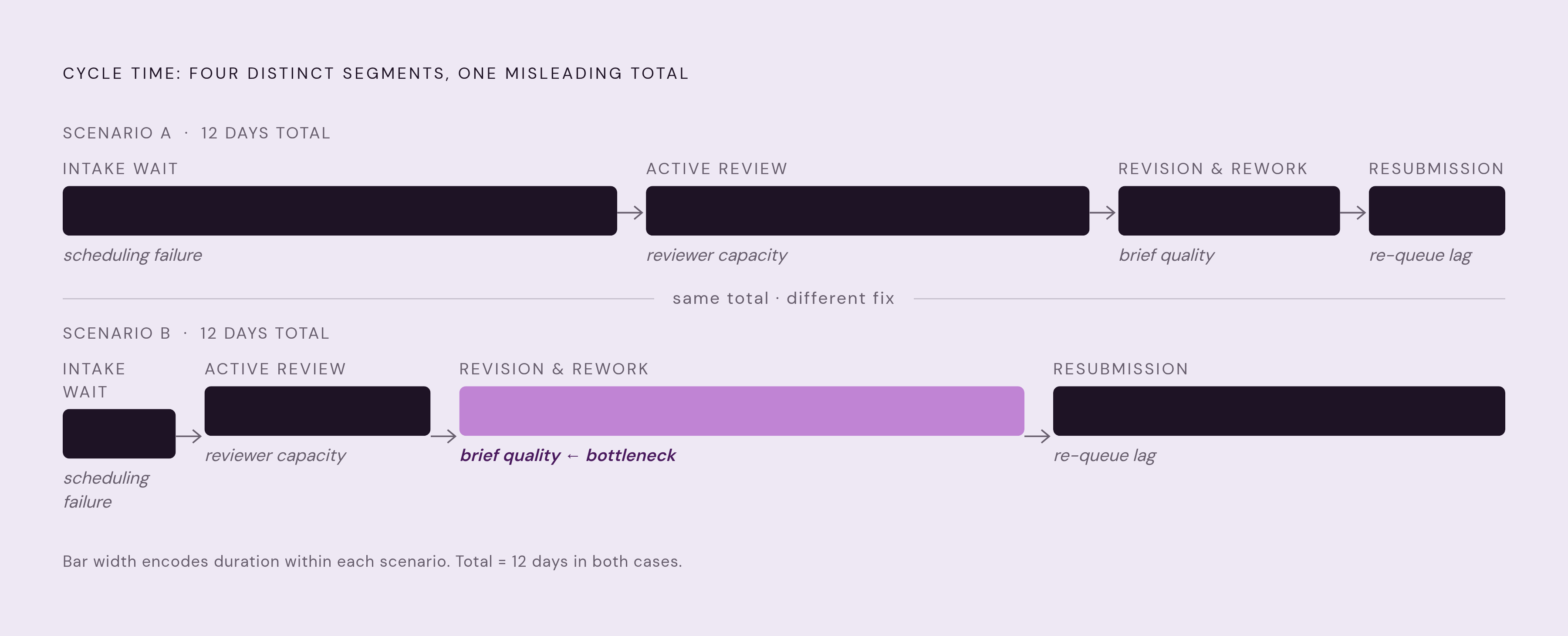
Cycle time, the total stretch from submission to final approval, gets cited more than any other MLR metric, mostly because it's the easiest one to put in a slide. But the numbers vary wildly depending on who's counting and where. Mid- and large-size pharma companies commonly report 50 to 60 days per asset under standard workflows. The European market averages closer to 20 days, with a mean of 1.3 review cycles per asset. EY's figures put the current average around 24 days. Vodori's 2025 benchmark data shows average job duration at 14.8 days, up from 13.8 in 2024, with average review duration climbing to 7.6 days from 6.6.
None of these numbers is alarming on its own. What's worth sitting with is the direction. Vodori's year-over-year creep, a day here, an hour there, is the kind of drift that looks fine in any single quarter and problematic over three years. Cycle time as a single number tells you the process is slow, but it says nothing about where the time is going. It flattens four very different problems into one number and calls it a diagnosis.
A submission that sits in an inbox for nine days before anyone opens it produces the same total cycle time as one that gets reviewed same-day but bounces through four rounds of rework. Treat those as identical and you'll apply the wrong fix every time, probably by hiring more reviewers to solve a scheduling problem. Break cycle time into its parts, intake wait, active review, revision and rework, resubmission, and the number becomes a map instead of a scoreboard. The rest of this piece walks through what each segment is actually telling you, and which fix belongs to which one.
Time-in-queue as a signal of reviewer overload and submission scheduling failure
Time-in-queue measures how long an asset waits before anyone starts reviewing it, which is a different animal entirely from how long the review itself takes. A long queue is almost never a reviewer performance problem. More often it's a system design problem wearing a reviewer's name tag.
The usual suspects are predictable once you look for them. Reviewer bandwidth collapses around product launches and campaign peaks, when submission volume spikes but headcount doesn't. Materials of wildly different risk levels get routed through the same full-committee process, so a minor channel adaptation waits in the same line as a new efficacy claim. And in a lot of organizations, there's no submission scheduling or demand forecasting at all. MLR gets treated as an inbox to throw things into, not a capacity system to plan around.
Promotional Review Committee meetings offer a decent informal gauge of how bad this has gotten. These committees meet on scheduled cycles, and sessions running four hours or longer are common. That points less to an overworked team than to the absence of an escalation path or exception process, so every edge case has to get litigated live, in the room, by committee. Worth watching for the pattern behind the number, too: if queue time spikes without submission volume rising alongside it, that points to a capacity cut, headcount loss or people getting pulled onto other priorities. If queue time rises in step with volume, that's a forecasting failure. Different diagnosis, different fix, and conflating the two is how teams end up throwing headcount at a scheduling gap.
Revision round count and first-pass approval rate as upstream content quality signals
Track these two together, because they're really one signal viewed from opposite ends: revision round count (how many passes an asset needs before approval) and first-pass approval rate (the percentage that clear review with no changes at all).
Multiple revision rounds per asset are a broadly recognized dysfunction signal in the industry. The European benchmark of 1.3 cycles per asset gives a useful sense of what a well-run process actually looks like by comparison. When revision counts run high, the cause usually sits upstream of the reviewer's desk entirely: briefs that never specified what the asset needed to accomplish, first drafts sent to review before anyone internally agreed on the core message, reviewers applying inconsistent standards from one cycle to the next, or cross-functional disagreements that should have been settled at the briefing stage instead surfacing mid-review as a fight over language.
A lot of the time lost in MLR is spent redoing work that failed to meet expectations nobody wrote down in the first place. That's worth saying plainly, because the instinct when revision counts climb is almost always to add another review layer, and that instinct usually points the wrong way.
First-pass approval rate deserves particular attention because it's a leading indicator: it starts sliding before total cycle time does. A team watching only cycle time will miss the early warning entirely and only notice the problem once it's already expensive. Catch a declining first-pass rate early, though, and you're catching the failure while it's still cheap to fix. The fix, when revision counts climb, sits almost entirely in briefing quality and internal alignment before the asset ever reaches a reviewer's queue. Rarely does it belong at the review stage itself, no matter how tempting it is to route around a slow reviewer instead of a broken brief.
Submission completeness and pre-submission rejection rate as the earliest-possible failure signal
Pre-submission rejection rate measures something that happens even earlier: how often a submission gets bounced back at intake, before formal review starts at all. This is distinct from revision round count, which measures rework after review has already begun.
A complete submission needs stable copy, claims mapped to their source references, a clearly defined audience and channel, an assigned version number, and layout close enough to final that a reviewer can actually judge it in context. Miss any of that and the asset doesn't just get delayed. It eats reviewer attention that should be going toward substantive judgment calls about legal exposure or scientific accuracy, not chasing down which footnote goes with which claim.
The structural root of this problem is usually a content library that doesn't function as one. Approved messaging living scattered across shared drives, email threads, and whoever happens to remember the last version, rather than in one governed source, means content creators are drafting against references they can't actually confirm are current or authorized. A rising pre-submission rejection rate is telling you that environment is getting worse: briefing standards have slipped, the library has become unmanageable, or new hires haven't been trained on what a submission is supposed to include.
This one is worth flagging separately because it's the most fixable metric on the list, and arguably the most neglected. Reviewer bandwidth and regulatory complexity are largely outside marketing's control. Submission completeness sits entirely inside it, which makes a chronically high rejection rate less a fact of life and more a choice nobody's owning.
Comment volume and comment type distribution as a measure of where reviewer capacity is being consumed
Total comment count matters less than what kind of comments are piling up. Substantive comments, the ones flagging scientific accuracy, legal exposure, or regulatory compliance, are what a review is actually for. Mechanical comments, formatting errors, missing disclaimers, incomplete references, the wrong version number attached, are administrative housekeeping that shouldn't require a physician or a lawyer's time at all.
When the comment log is dominated by the mechanical kind, expert reviewer hours, the most expensive and scarce resource in the entire process, are being spent catching problems an editorial checklist should have caught first. That's the review team doing authorship's job for it, and no amount of hiring more MDs onto the review committee fixes a missing checklist.
The distribution tells its own story if you read it closely. A flood of mechanical comments points to weak submission standards. A concentration of substantive comments around one specific claim category suggests a training gap on that therapeutic area, or a hole in the approved claims library. Substantive comment volume rising without a matching rise in submissions suggests the regulatory environment or internal standards shifted and authorship hasn't caught up yet. And if the same type of asset draws wildly different comments from different reviewers, the problem lives in standards alignment among the reviewers themselves, not in the content.
Tracking any of this requires a system built to capture it, a workflow platform rather than a scattered email chain, and this is frequently the first wall teams hit when they try to actually operationalize these metrics. You can't diagnose what nobody logged.
Expedite request rate as a proxy for how well campaign planning and MLR are integrated
Expedite request rate is the share of total submissions flagged as rush or priority. Industry guidance holds that figure should stay under 10% of total volume, with approval routed through an MLR committee chair rather than left to whichever marketer is in a hurry that week.
Start with that benchmark, then push on it a little. When expedite requests blow past 10%, it's rarely because a tenth of all campaigns genuinely hit some unforeseeable emergency; genuine emergencies are, by definition, rare. What a high expedite rate usually signals is that campaign timelines are getting built without any review buffer at all, that MLR is treated as a rubber stamp bolted onto the end of the process rather than a partner brought in during campaign development, or that marketers have simply learned the expedite lane exists and use it as a scheduling shortcut rather than an emergency valve. Once every submission gets treated as urgent, the label stops meaning anything.
There's an organizational angle worth naming here too. Compliance accountability structures vary widely across organizations, and a chronically high expedite rate is fairly direct evidence that whatever shared model exists isn't actually functioning, whatever the org chart claims.
One useful cross-check: if expedite rate is high but first-pass approval rate is also high, the content itself is fine and the problem sits entirely upstream in planning. If both numbers are running hot at once, that's two failures compounding, not one, and it takes two separate fixes to unwind them.
Throughput rate and unused asset rate together as a signal of systemic misallocation
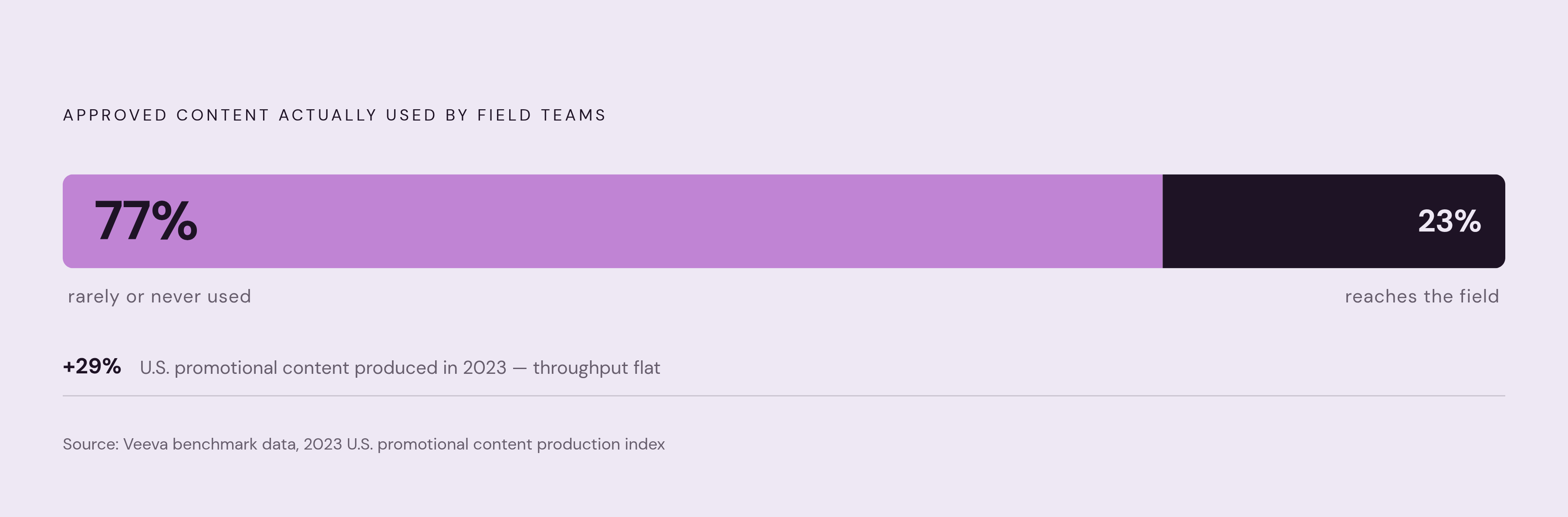
Throughput rate, how many assets clear review in a given stretch of time, is a capacity signal. When content production keeps climbing but throughput stays flat, MLR is falling behind demand, full stop. Given that content production rose 29% in the U.S. in 2023, that gap has had plenty of room to open up across the industry.
Here's the number that should make anyone pause: Veeva benchmark data puts the share of approved content that's rarely or never used by field teams at 77%. Read that next to a low throughput rate and the diagnosis shifts entirely. Low throughput plus high unused-asset rate points to a resource allocation problem more than a speed problem: reviewer hours spent approving material that will sit unopened on a rep's tablet until someone archives it.
That's a strategic governance failure more than an operational one. Content strategy and MLR capacity planning are running on separate tracks that never talk to each other, and the result is teams burning scarce reviewer time perfecting the footnotes on assets nobody will ever open. What the data doesn't answer, and what any team should be digging into with its own numbers, is which assets are the ones going unused. Channel adaptations that never got picked up? Regional variants nobody localized properly? Launch materials that outlived the campaign they supported by six months? Without that breakdown, the fix stays theoretical. Basic portfolio discipline, tracking what actually gets used, what gets adapted, what just gets archived, is what generates the input data needed to decide what should enter the MLR queue in the first place.
Accountability gaps that metrics alone can't capture — but that metrics make visible
Metrics are good at telling you something's broken. They're less reliable at telling you whether the break is operational or structural, and that distinction is worth sitting with before reaching for a process fix that can't actually touch a structural problem.
A 2024 promotional-review benchmark from Canopy asked Medical Affairs teams a simple question: who owns promotional review? 44% pointed to the medical director, 23% to medical information, and only 15% to a dedicated promotional-review function. Fragmented ownership is the default setting across the industry, not the exception, and it's worth saying so plainly instead of treating it as a quirky footnote.
When ownership is scattered like that, MLR ends up absorbing coordination work it was never built to own, functioning as an accidental project manager chasing down sign-offs, which inflates both queue time and meeting length without improving a single compliance outcome. Those four-hour PRC meetings mentioned earlier aren't just a scheduling nuisance. They're a symptom of a governance structure that never built an exception path, so every edge case gets resolved live and in committee instead of by policy.
Geography adds another wrinkle worth noting. MLR and PRC are American terms; European and UK frameworks tend to use "medical approval," with a single named signatory personally accountable for the asset. The underlying review work looks similar on paper, but the accountability model differs sharply. U.S. teams without a clear single point of ownership for each asset will see that gap show up indirectly, in revision round counts that won't come down and escalation rates that keep climbing no matter how the workflow gets tweaked.
Watch for the combination: rising cycle time, a high expedite rate, and bloated meeting cadence showing up together. That trio, taken as a set, usually points to an accountability gap rather than a content quality problem or a reviewer capacity shortage. Diagnose it as either of those instead, and the fix will look busy without actually working.
What optimized MLR performance looks like in practice — and how teams get there
None of this is unsolvable, and the industry has receipts to prove it. EY Aqurance data shows companies that optimized their MLR workflows achieved a 57% reduction in review cycle times and a 55% drop in time spent in review meetings. One documented case involved a pharma company running a twelve-week average cycle time, long enough to routinely miss market windows entirely, that brought approval cycles down to three weeks by introducing modular content, embedding compliance checks directly into the workflow, and retraining the teams doing the authoring. McKinsey data separately points to some pharma companies cutting regulatory submission timelines by roughly half to two-thirds through workflow redesign and AI-enabled automation.
The interventions map cleanly onto the metrics above, which is really the point of tracking them in the first place. Cycle time and queue time respond to risk-tiered routing and structured submission scheduling, sending low-complexity adaptations down a fast track instead of forcing everything through full committee. Revision counts respond to better briefing discipline and pre-review alignment, catching disagreements before authorship starts rather than during review. Pre-submission rejection rates respond to a genuinely governed content library, one source of truth instead of six shared drives. Expedite rates respond to bringing MLR into campaign planning early instead of treating it as the last stop before launch.
Most of these fixes are a matter of routing decisions and checklist discipline rather than new technology, though pre-approved content modules and workflow platforms clearly help teams that are ready to scale the effort. The harder part, and the one most organizations skip, is treating the metrics themselves as an early-warning system worth checking regularly, rather than a compliance report filed away until someone remembers to ask. Given the current enforcement climate, that's homework nobody can still afford to skip.