FDA Draft Guidance on Directional Risk Information in Promotional Labeling
Sixteen-year-old draft rules now guide how FDA polices drug risk disclosures.

FDA's draft guidance on presenting risk information in promotional labeling spells out, in specific and often granular terms, how drug and device marketers have to display risk alongside benefit claims. It’s 16 years old, not finalized, and by September 2025 regulators were cracking down harder and more often than anyone in the field had witnessed in years.
Let's start with the plumbing, because it's crucial. Promotional labeling includes all materials other than FDA-required labeling that a manufacturer, packer, or distributor uses to advertise a product. "Promotional labeling" is legally distinct from "advertisement." The Food, Drug, and Cosmetic Act regulates all drug labeling, while 21 CFR Part 202 specifically governs prescription drug ads. The law says each drug ad must list side effects, contraindications, and effectiveness. On top of that comes the fair balance rule: any claim about how well a drug works must be matched with clear information about its risks, not hidden where people won’t see it. Companies file these pieces with FDA on Form FDA-2253 the first time they're published, and the rule covers everything from a 30-second TV spot to a tweet, aimed at doctors or patients alike. These requirements apply to all promotional materials from the time of first publication.
The 2009 draft guidance that still governs how FDA evaluates risk presentation
The main document handling this is called "Presenting Risk Information in Prescription Drug and Medical Device Promotion," Docket No. Issued in May 2009, FDA-2008-D-0253. The FDA Office of Prescription Drug Promotion website still lists it as a draft. Still not finalized or withdrawn, a sign of either bureaucratic inertia or quiet confidence in the framework’s adequacy. Either way, it's what FDA reviewers reach for, and it covers every prescription drug and device across CDER, CBER, CVM, and CDRH, regardless of medium or audience.
The core test the guidance sets up is called net impression. The FDA doesn't just verify that each risk statement is correct, it checks if the overall message gives an accurate view of benefits and risks. The FTC uses this same basic approach to judge deceptive ads, so pharma marketers aren’t facing some strange rule made up in a windowless room at 10903 New Hampshire Avenue. This test is widely used by regulators.
Materiality follows from that. The biggest risks listed for a product are, by their nature, key to any statement about how well it works. The same goes for the most frequently occurring risks, especially when a drug doesn't have many serious ones on its label to begin with, since the odds of those risks actually touching the target population go up. That’s when things seem to flip: the FDA tells companies not to cram every risk into ads. Piling on lots of minor side effects doesn't help anyone. It buries the risks that actually matter under a pile of ones that don't, and comprehension goes down as a result. By far, the most frequent violation in FDA enforcement letters is the omission or downplaying of risks. Not exaggerating benefits or making up data. Just risks that are left out, downplayed, or buried.
How the guidance treats format, hierarchy, and language, not just what risks to include but how to present them
The 2009 guidance outlines multiple review criteria. Each one carries its own set of expectations, and treating them as interchangeable is a mistake that shows up again and again in enforcement letters.
General considerations cover things like consistent language (a risk term shouldn't quietly shift meaning halfway through a piece), the use of visual or textual signals that flag risk information as risk information, how a risk is framed (technically true language can still mislead depending on how it's phrased), and hierarchy, meaning the most serious risks need visual or verbal weight that matches their seriousness relative to lesser ones.
Content considerations are about quantity and clutter. Risk information should be sufficient for a clear understanding, yet not so overwhelming that critical risks are lost among less significant details. There's a clear design challenge here: too much detail makes things confusing, and the guidance clearly states that the aim is to make risks easy to remember and act on, not just to list every rule on the page.
Format is where things split by channel. Print has its own set of expectations, addressed further in a 2015 revised draft. Each medium, broadcast, digital, social, has its own formatting rules, and here’s where clear violations pop up: visuals that drown out the risk statement. A voiceover with loud background music, an announcer reading contraindications while a graphic flashes, or a split-screen that distracts from the risk disclosure. This isn’t just a matter of style. This is grounds for documented enforcement action.
Why focus so much on format? FDA's own research, cited in the 2009 guidance, found that 60% of physicians believe patients understand little or nothing about the risks presented in direct-to-consumer ads, and 72% believe the same about risk comprehension generally from DTC advertising. Those numbers completely justify the format rules. When people don’t take in what’s shown, the issue lies with how it’s displayed, not just what’s said.
The specific guidance documents that apply to particular product types and channels
A set of guidance documents tailored to particular product types and channels sits on top of the 2009 framework, and figuring out which one applies to a specific piece of content is key to compliance.
For consumer-directed print ads of human and animal prescription drugs, there's the "Brief Summary and Adequate Directions for Use" revised draft from August 2015 (Docket No. FDA-2004-D-0500). This rule covers print ads, not TV or radio. A common practice was to reprint the risk sections from the FDA-approved package insert, including all the dense regulatory language. FDA encourages sponsors to present risk information in language appropriate for the target audience. A drug label aimed at doctors won’t make sense to someone seeing a magazine ad, and the FDA’s now made that clear.
For quantitative claims in DTC materials, the relevant document is the final guidance on "Presenting Quantitative Efficacy and Risk Information in DTC Promotional Labeling and Advertisements," finalized in December 2023 (Docket No. FDA-2018-D-2613). This guidance applies to any numerical claim about a drug's effect or risk.
On December 9, 2025, biologics and biosimilars received final guidance titled "Promotional Labeling and Advertising Considerations for Prescription Biological Reference Products, Biosimilar Products, and Interchangeable Biosimilar Products." This mandates disclosing all key facts, showing risks with benefits, updating promotions promptly after label changes (especially risks), and prohibits suggesting biosimilars differ in safety, purity, or potency without proof. Postmarketing submission rules also apply, with the correct forms used when material is first distributed.
FDA provides guidance for social media and character-limited platforms, with risk and benefit disclosure requirements. Character limits do not exempt content from regulatory requirements.
The broadcast "adequate provision" standard and why FDA now considers it a loophole
Broadcast advertising has always been a strange animal under 21 CFR 202.1, which requires a brief summary of side effects and contraindications, unless "adequate provision" is made for the approved labeling to reach the audience some other way. Before 1997, that rule basically limited DTC ads to print since FDA never explained what "adequate provision" meant for a 30-second TV commercial.
The 1997 draft guidance, finalized in 1999, opened that door. It stated that a "major statement" about key safety risks, along with easy access to complete prescribing details (like a 1-800 number, website, or print ad), meets the rule. That’s what allowed DTC ads to spread rapidly on TV and later online.
FDA now calls this the "adequate provision loophole," in its own public language, which is a pretty clear tell about where things are headed. The new rules would set a much higher standard: TV and radio ads would have to include a complete brief summary of side effects and warnings, similar to print ads. This kind of formal rulemaking usually takes over a year to complete, including a public comment period, and a final rule will likely face a First Amendment commercial speech challenge. Whether that challenge succeeds is a separate question. There’s no doubt about the direction FDA wants to move.
What triggered the September 2025 enforcement surge and what it looked like in practice
On September 9, 2025, President Trump ordered HHS to demand more risk details in drug ads and told the FDA to enforce existing ad rules in the FD&C Act. The memo came after a Make America Healthy Again Commission report urging FDA, HHS, FTC, and DOJ to strengthen oversight of DTC ads, especially online, something HHS Secretary Kennedy had long supported.
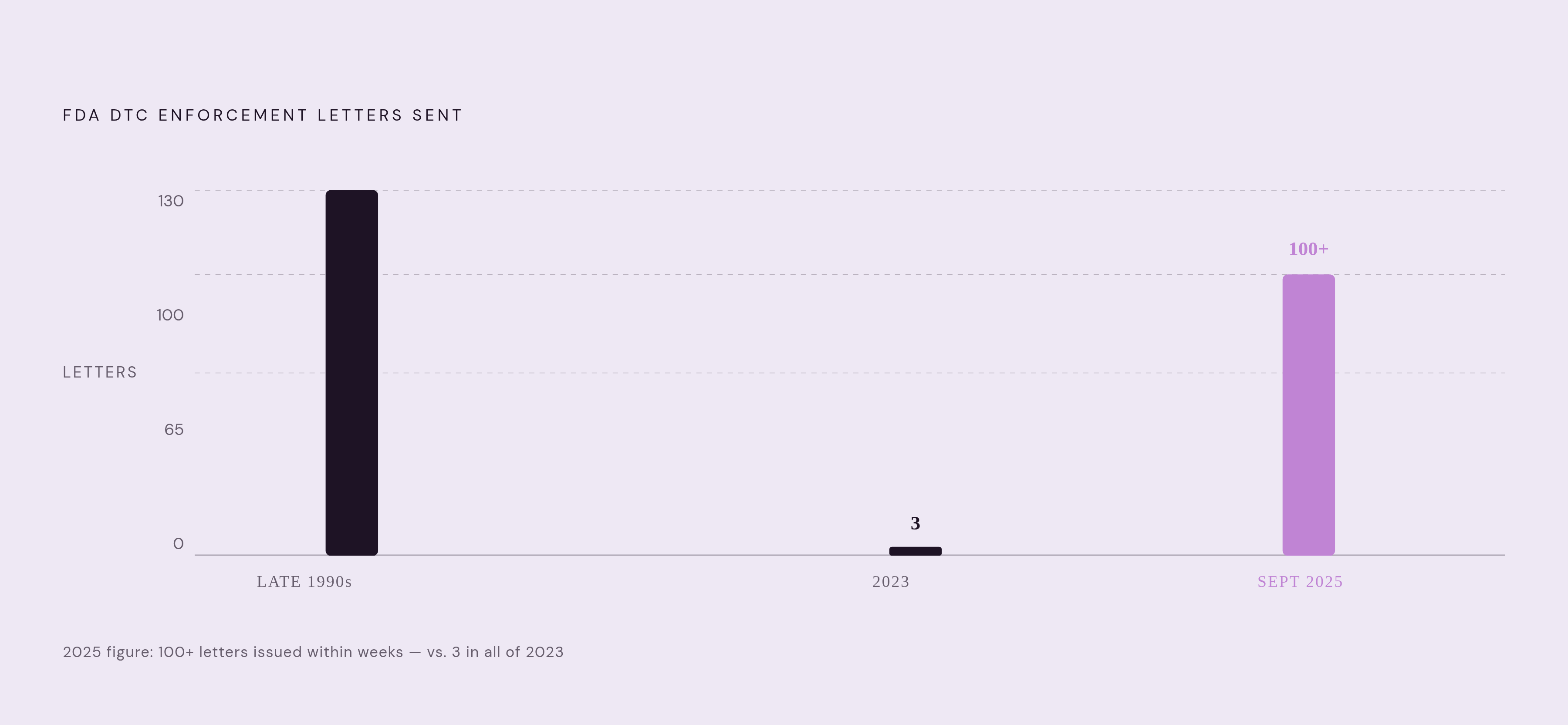
The scale of what happened next is worth sitting with. In the late 1990s, the agency sent out over 130 DTC enforcement letters annually. It dropped to three by 2023. Only three letters were sent in a whole year across all DTC advertising. Then, in early September 2025, FDA sent more than 100 enforcement letters to pharmaceutical companies and compounding firms in a matter of weeks, reversing roughly two decades of declining enforcement in a single month.
What did the letters actually cite? Exaggerated effectiveness claims combined with weak risk disclosure in direct-to-consumer video ads. Highlighted benefits that didn't line up with the product's approved indication in its prescribing information. Efficacy claims without adequate clinical support. And visual presentations that distracted from the major statement, where the risk disclosure was present but got lost in what was happening on screen. Most of the letters focused on online ads for compounded GLP-1 products, while DTC video ads were a smaller yet notable part.
One procedural detail stands out for anyone who tracks how these things usually work: the September 9 letters were signed at the center director level, by CDER's Dr. Tidmarsh and CBER's Dr. Prasad, rather than by OPDP or the Advertising and Promotional Labeling Branch leadership, which is the customary signatory. That's not a footnote. It suggests the internal review and sign-off process looked different this time, and different processes tend to produce different outcomes. The FDA sent another batch of untitled letters on September 25, targeting promotional materials for healthcare professionals this time. FDA has also announced plans to use AI tools to increase enforcement reviews and will broaden oversight to cover all social media promotions, including influencer deals and sponsored posts. So the enforcement surge isn't a one-time correction. It reads more like a new baseline.
The practical compliance requirements that fall directly out of these standards
Remove the guidance-document numbers and docket citations, and you’re left with a brief list of specific requirements.
Benefit claims must always include risk information, not tuck it away in small print. Hierarchy matters as its own discipline: serious risks need the visual or verbal weight to match their seriousness, and minor ones shouldn't be allowed to crowd them into the margins. The FDA's real test is net impression, so a piece can pass every single requirement and still fail if it leaves an overall impression that favours benefit. Visual and audio parts are treated as content, not decoration; music, motion, or competing graphics in a risk disclosure have led to actual violation letters, not just theoretical ones.
Labeling updates must now be made quickly. The December 2025 biosimilars guidance says promotional material must be updated quickly when approved labeling changes, especially anything touching risk, and there's no reason to think that expectation is unique to biosimilars rather than a signal of where FDA's general posture is heading. Consumer-directed print material allows some leeway: sponsors should rephrase package insert text into language patients can understand, instead of copying regulatory wording exactly. Quantitative claims, meanwhile, get their own layer of scrutiny under the 2023 final guidance, so any number describing efficacy or risk needs care in how it's framed next to the corresponding risk data. Form FDA-2253 gets filed the moment a piece first goes out, not after the fact and not on request. Social and digital channels aren't exempt. FDA has clearly stated that it is increasing oversight of all social platforms, no matter the format or length.
How content production workflows can be structured to keep risk presentation compliant at speed
None of this is a one-time clearance event that a piece passes and then forgets about. Labels change, enforcement gets new interpretations, and channel standards evolve, so risk info must be part of the regular production process, not just tacked on at the end.
The same failure patterns keep appearing in enforcement letters. Benefit claims get written first, and risk language gets bolted on at the last minute, which almost guarantees a hierarchy or balance problem downstream. Designers may chase eye-catching layouts but miss that extra visuals during key warnings are a known compliance fail, not just style. Legal or regulatory review often comes at the end, a hurdle to clear instead of criteria in the creative brief from the start.
A stronger setup includes risk presentation within the brief itself. Since the net impression standard requires the entire piece to be balanced from the start, balance must be a design constraint in the first draft, not an afterthought before submission. Channel-specific templates, one for print, one for broadcast, one for digital, one for social, can encode the medium-specific rules from the guidance documents directly into the production process, cutting review cycles without cutting corners. AI-assisted drafting plus regulatory review can speed things up while keeping the accuracy and hierarchy FDA wants; those goals don’t clash, they just need a workflow designed to handle both together. And a standing process that flags FDA labeling updates and triggers a prompt review of whatever promotional material is currently live is, at this point, closer to a baseline requirement than a nice-to-have.
There’s no room for delays anymore. Content drafted in full compliance can quickly become non-compliant if the underlying labeling changes, and with the FDA's rapid action in September 2025, relying on trial and error isn't a viable plan.
Sources
- Regulatory NewsBREAK: The FDA Releases Final Guidance on Promotional Labeling and Advertising for Prescription Biologicals, Biosimilars, and Interchangeable Biosimilars | AMCP.org
- FDA Begins Crackdown on Direct-to-Consumer Pharmaceutical Advertising
- Guidance for Industry Presenting Risk Information in Prescription Drug and Medical Device Promotion
- Promotional Labeling and Advertising Considerations for Prescription Biological Reference Products, Biosimilar Products, and Interchangeable Biosimilar Products: Questions and Answers
- Brief Summary and Adequate Directions for Use: Disclosing Risk Information in Consumer-Directed Print Advertisements and Promotional Labeling for Prescription Drugs Guidance for Industry
- Federal Register :: Request Access
- federalregister.gov
- ropesgray.com