Modular content in pharma marketing: what breaks when you try to reuse approved claims across channels
Modular content only works if you account for how channels change what claims actually mean.
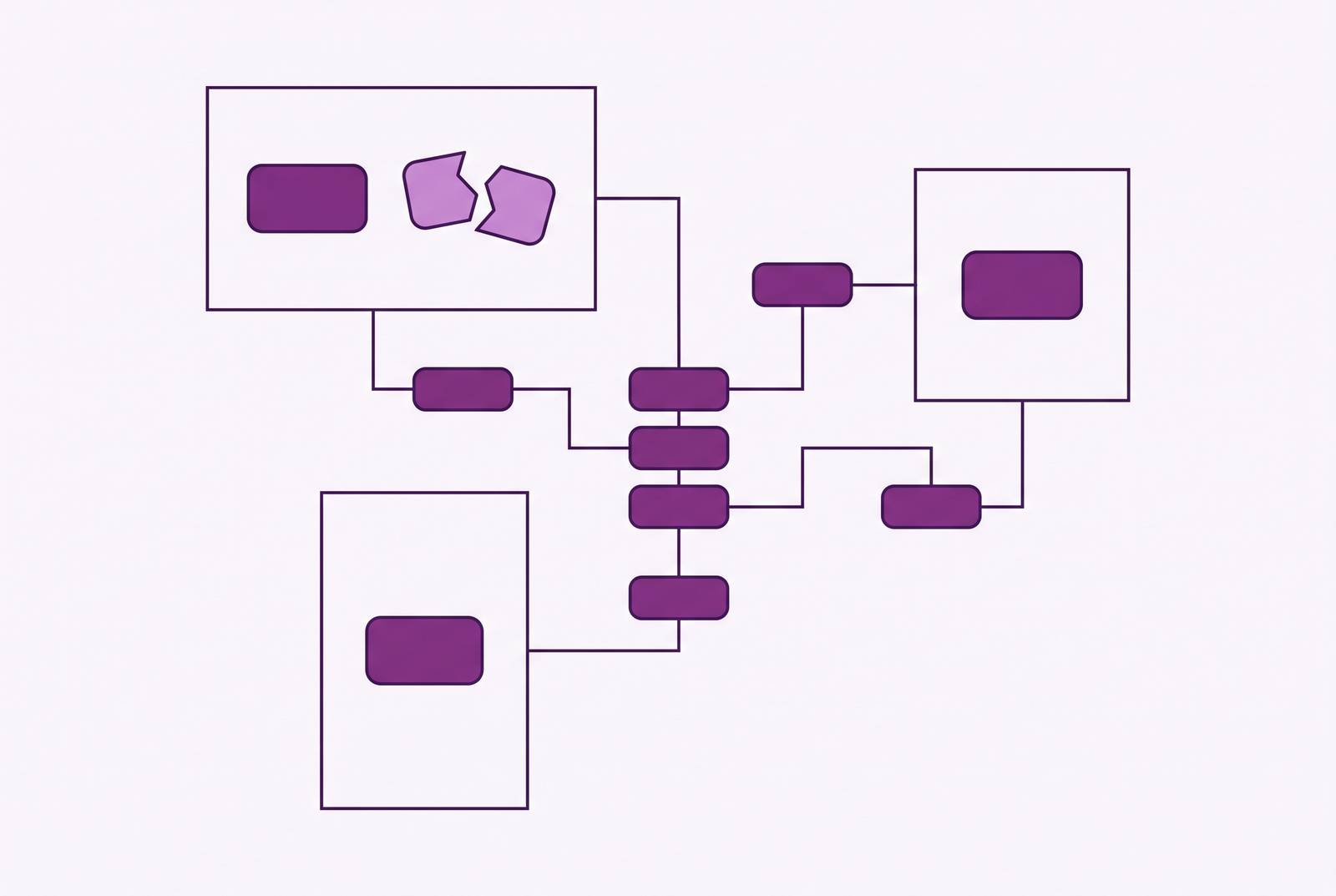
Modular content is one of those ideas that sounds like a solved problem until you actually try to implement it. The premise is elegant, the business case is obvious, and the early pilots almost always look promising. Then, somewhere between the governance deck and the first real product launch, things start to quietly fall apart. Not catastrophically. Quietly. That's what makes it expensive.
What the System Is Actually Supposed to Do
The concept isn't complicated. You take a claim, lock it together with its supporting references, its fair balance language, and its visual treatment, and you get it reviewed and approved as a unit. That unit becomes a building block. Writers and designers pull from a library of these blocks to assemble new materials without triggering a full review cycle, because the underlying content has already been vetted. Medical, legal, and regulatory reviewers only need to touch what's genuinely new.
In a function where approval cycles routinely stretch across weeks or months depending on asset type, indication, and the temperament of any given review committee, that compression matters. Companies are leaving real time and money on the table every time they rebuild from scratch what could have been reused. Modular content is supposed to be the fix.
The logic holds. The execution is where teams find out what they didn't account for.
The Channel Problem, Which Is Actually a Context Problem
The assumption that causes the most damage is this: that a claim approved for one channel transfers cleanly to another.
It doesn't. Not automatically, not without scrutiny, and not just because the regulatory framework says so. Because the channel isn't a neutral delivery vehicle. It's part of the claim's meaning — like a picture frame that changes how you see the painting inside it.
A claim approved for a detail aid lives inside a specific visual and contextual architecture. The font, the proximity to fair balance language, the page real estate surrounding the claim, the reading sequence the audience follows: all of that is part of what reviewers saw and approved. When you lift that claim and drop it into a 300x250 digital banner, you haven't reproduced the approved context. You've created a new one.
I once watched a content team adapt a long-form asset for digital display. Qualifying language that was clearly visible in the original literally could not fit the new format. Their solution was to remove it entirely. The module was "approved." The context was not. The distinction cost them a full re-review cycle they had specifically been trying to avoid.
The same dynamic applies moving from a print journal ad to an email, from a website module to a leave-behind, from a congress panel to a patient-facing brochure. Each channel imposes its own constraints on space, hierarchy, reading sequence, and audience literacy. A claim that reads as appropriately qualified in a long-form clinical document reads as absolute and unqualified when it stands alone in a six-word headline. Regulatory reviewers understand this intuitively. Marketing teams, under deadline pressure, don't always stop long enough to reckon with it.
The Drift Inside the Claim Itself
There's a second failure mode that lives inside the claim itself, independent of channel entirely.
Approved claims carry a specific data anchor. The wording is deliberate because it reflects exactly what the clinical evidence supports, and often reflects hard-won negotiations between the medical, regulatory, and marketing functions about where the boundaries are. "In clinical trials, patients experienced..." is not the same claim as "patients experience..." That's a tense shift. It's also the difference between a historically bounded finding and a universal present-tense assertion — or, to put it plainly, the difference between "we observed this" and "this is always true."
When content teams adapt modules for reuse, small editorial adjustments accumulate. Someone shortens a sentence to meet a headline character limit. Someone converts passive voice to active voice for readability. Someone removes a qualifying clause because it crowds the design. Each individual change feels minor. Collectively, they can migrate the claim out of its approved state without anyone recognizing that a threshold has been crossed.
This is the compliance risk that modular content programs underestimate most consistently. It doesn't look like a violation. It looks like good copywriting. That's exactly why it persists.
Governance Is the Product
Teams that make modular content work share one structural trait above all others: they treat the governance system as a product in itself, not as administrative overhead that exists alongside the real work.
That means a content taxonomy rigorous enough to track not just what a module says, but where it's approved to appear, under what conditions, and with what mandatory companions. It means version control that retires outdated modules quickly, so writers can't reach for an approved block built against superseded data. It means clear, practical rules about what constitutes an adaptation requiring re-review versus what qualifies as true reuse.
Most organizations have some version of this on paper. Fewer have it functioning consistently enough to prevent drift at scale. The gap between the governance document and the governance reality is where most modular programs actually live.
The Audience Variable
Pharma marketing addresses multiple audiences, sometimes with the same underlying science. Physicians, patients, payers, and managed care decision-makers are not interchangeable in how they receive and interpret a claim. A statement calibrated for a clinical professional who will read it inside a body of supporting evidence lands very differently when it reaches a patient who encounters it in isolation, without the surrounding context that made it appropriate.
Modular systems built primarily around the HCP channel tend to struggle when organizations try to extend reuse into patient-facing or payer-facing materials. The module wasn't designed with that audience's interpretive context in mind. The approval didn't account for it. The fair balance requirements differ, sometimes significantly.
Forcing HCP modules into non-HCP channels is one of the more predictable sources of compliance exposure in modular programs, and one of the more avoidable ones, if the system was built with audience as a defining variable from the start rather than appended later as a filter.
What the Programs That Actually Work Do Differently
The organizations that consistently derive both speed and compliance benefit from modular content made a few deliberate choices earlier in the process than their peers.
They define the module at a level of granularity that reflects real channel constraints, not idealized content abstractions. A module isn't just a claim. It's a claim, built for a specific audience tier, within a defined range of channel environments, with all required surrounding elements specified. That level of specificity feels like overhead at the design stage. It prevents the expensive rework that comes later.
They invest in training content teams to understand why a qualifying clause exists, not just that it must be preserved. Writers who understand the clinical and regulatory reasoning behind specific language are far less likely to remove it casually than writers who experience it only as an obstacle to clean prose. The difference in outcomes is meaningful.
They also build feedback loops. When a module gets flagged in review because of how it appeared in a specific channel context, that information goes back to the library governance team, not just to the individual asset owner. The system learns from its own edge cases rather than repeating them under a different asset number.
The Real Constraint
Modular content is a precision instrument that requires a precision operating environment. The premise — faster time to market with maintained compliance rigor — is worth pursuing. But that outcome is only achievable when teams resist the pressure to treat approved modules as unconditional approvals rather than context-dependent ones.
The channel shapes the claim's meaning. The audience shapes its impact. The cumulative weight of small editorial choices shapes its compliance posture. Until modular content programs are built with those realities embedded in their architecture from the beginning, the time savings and the compliance integrity will continue to trade off against each other. They only coexist when the system was designed to hold both at once.