Parallel Review Workflows in Pharma Promotional Development
MLR runs as three separate mandates, Medical, Legal, and Regulatory, under a single committee structure, and most companies still route them like an assembly line when they don't have to.
Parallel review lets Medical, Legal, and Regulatory look at the same promotional asset at the same time, instead of passing it down a chain from one function to the next. That single structural change is the biggest lever pharma teams have for cutting MLR cycle times without cutting the scrutiny regulators expect. It demands coordination work that sequential review never had to bother with, though, and skipping that work is exactly how a "faster" process ends up slower than the one it replaced.
Medical checks scientific accuracy: does the claim track with the approved label and the published clinical data behind it? Legal checks liability exposure, intellectual property, and whether the disclaimer language actually holds up if someone reads the ad wrong on purpose. Regulatory checks fair balance, mandatory statements, and formatting against whatever guidance applies. Some organizations use "MLR" and "PRC" (Promotional Review Committee) interchangeably; others treat the PRC as the standing body that runs the MLR process, and that distinction is worth keeping straight before anything else here makes sense. The scope is broad: sales aids, patient brochures, digital ads, congress posters, anything that touches a physician or patient with intent to promote, including the graphs and infographics alongside the paragraphs next to them.
The stakes aren't abstract. U.S. companies paid roughly $9.8 billion in 2022 to settle False Claims Act violations tied to improper promotion, a number that explains why nobody wants to be the one who suggested skipping a review step to save a Tuesday.
Why sequential review became the default and what it actually costs
Sequential review is the assembly-line version of MLR: Medical reviews the draft and sends it back, Legal picks it up and sends it back, Regulatory closes it out. Every handoff adds queue time, even when each reviewer moves fast, because the document just sits in someone's inbox until they get to it. It stuck around for a reason that has more to do with comfort than efficiency. A linear trail feels auditable. Each function's sign-off is a visible checkpoint, and compliance teams like being able to point to a clean chain of custody when someone asks who approved what and when.
The cost shows up on the calendar. Under standard workflows, review cycles commonly stretch to 50 to 60 days per content piece at mid-size and large companies. Smaller organizations still running review over email, and there are more of these than you'd guess, often land at 30 to 45 days from coordination overhead alone, before any real substantive review has happened. A month can pass before a reviewer has said a single word about the science.
A good chunk of that delay isn't even review time. It's rework, and rework usually traces back to expectations nobody wrote down before the content team submitted the piece. Nobody flagged which claims were pre-approved, so the draft used one that wasn't, and now everyone's redoing a week of work over a conversation that should have happened before the brief went out.
Then there's the commercial math. Per Veeva, average annual drug approvals in the life sciences industry have increased roughly 60%, which means more products fighting for the same launch windows and the same slice of physician attention. Every week lost to cycle time is revenue displaced during the single most valuable stretch of a drug's commercial life, the early months when market position gets staked out.
Sequential review is still the right call for compliance-sensitive content that needs an unambiguous audit trail, and it's usually necessary for Tier 1 materials, where a Medical finding might completely change what Legal needs to look for. The choice between sequential and parallel is structural. It depends on what kind of content is actually sitting in the queue, not on which process feels faster in the abstract.
How parallel review works and what it actually requires to function
Parallel review means Medical, Legal, and Regulatory look at the same version of an asset at the same time, rather than in sequence. Simple to describe, harder to run.
Reviewers need explicit role boundaries so their comments don't collide on the same paragraph. Everyone needs one shared workspace showing all three sets of annotations together, so nobody's marking up a version that's already two revisions stale. And there has to be a structured reconciliation step after the simultaneous review: a defined moment where conflicting feedback gets resolved before it lands back on the content team's desk.
Skip any of that and parallel review turns into a mess fast. Without defined roles and a reconciliation mechanism, three reviewers working the same document at once just produces three sets of conflicting annotations and a contested revision that takes longer to untangle than sequential review would have taken in the first place. Parallel review only beats sequential when the coordination scaffolding actually gets built first. Build the scaffolding after the fact, once reviewers are already frustrated and comparing notes about whose feedback got ignored, and it's much harder to land.
So when does parallel review actually make sense? When the material only uses pre-approved claims, so reviewers are checking presentation rather than content originality. When the three functions' concerns genuinely don't overlap: Legal on disclaimer language, Medical on clinical claims, no real dependency between the two findings. And generally, for lower-risk tiers where a faster process carries acceptable risk.
Tier 1 materials are the exception worth calling out directly: if a Medical finding might change what Legal and Regulatory need to evaluate, forcing simultaneous review just creates rework dressed up as speed. Most organizations land on a hybrid: parallel review as the default lane for standard assets, sequential escalation reserved for high-complexity, high-sensitivity material, a routing decision made asset by asset rather than one policy applied across the whole portfolio.
Risk-based content tiering as the prerequisite for routing decisions
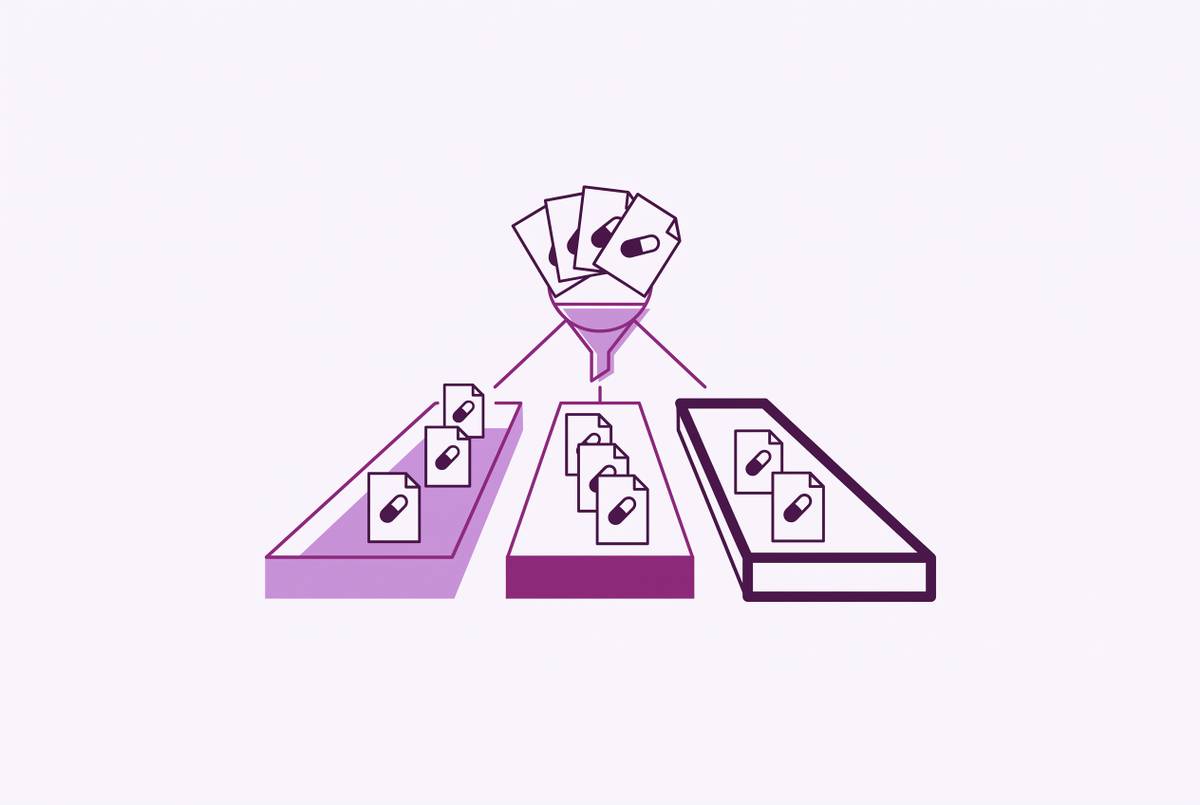
None of the above works without tiering, because tiering decides which lane an asset gets routed into before anyone touches the review workflow itself. Tiering classifies content by risk, weighing audience, whether the brand name appears, whether claims are pre-approved or net-new, product type, and distribution channel.
A rough version of the logic: low-risk material, internal training decks, corporate communications, carries minimal exposure and gets a lighter path. Mid-risk material, a new banner ad built from an old pre-approved claim, moves through parallel review with a reconciliation step. High-risk material, net-new claims, novel scientific messaging, sensitive patient populations, gets sequential or hybrid review with the full committee involved. Get this sorting wrong and everything downstream inherits the mistake.
The payoff compounds as content volume grows. Reviewers stop re-litigating low-risk content and put their attention where it actually matters, which is a capacity gain that scales rather than one that flattens out after the first quarter. Tiering is also what makes conference responsiveness possible: a time-sensitive derivative asset following a data readout or a congress presentation can move through the fast lane, using capacity that isn't being burned on lower-risk work anymore.
Per Veeva's documented tiered approach, tiers function as the gateway for routing decisions. Pull tiers out of the equation and parallel review becomes undifferentiated acceleration, the same speed applied to everything regardless of risk, which raises compliance exposure instead of managing it. Tiering also identifies which assets are candidates for the next structural piece: content built from pre-approved modules, where the workflow and the content architecture start reinforcing each other.
Modular content as the structural enabler that makes parallel review sustainable at scale
Modular content means breaking a promotional piece into discrete, independently approvable parts: claims, references, safety statements, disclaimers, approved visuals. Each piece gets cleared once. After that, pre-approved modules get reassembled into new assets without sending the components back through review; only the genuinely new elements ever enter the MLR queue.
That changes what reviewers spend their time on. Attention shifts to novel claims and new combinations of existing ones, instead of re-checking boilerplate cleared three campaigns ago. It changes the content team's math too. A new banner or follow-up email can get assembled from cleared modules in days, not weeks, because the highest-risk piece, the clinical claim or the safety statement, is already sitting in the library, approved and ready to go.
There's a consistency dividend that rides along with the speed: a shared module library keeps messaging aligned across channels, which cuts the odds that some variant quietly introduces an unapproved claim because someone copied language from an old deck instead of pulling from the current library.
The Veeva-reported figures deserve a closer look rather than a quick nod. Reuse-informed review cut average time to approval by 50% to 75% in documented customer deployments, alongside a 57% reduction in review cycle times and a 55% reduction in time spent in MLR or PRC meetings. Those numbers reflect modular content and workflow redesign working together; they don't isolate modularity's individual share of the gain. And modularity has a cost: building the library takes upfront investment and ongoing governance. Modules need version control, expired claims need to come out promptly, and the whole library needs periodic audit as labeling changes. Skip the governance and the library turns into a liability, which is the part vendor pitches tend to leave out.
Where technology platforms fit and what they cannot substitute for
The MLR software market reached over USD 5.9 billion in 2024, a figure that says as much about how tangled the compliance problem is as it does about how dependent organizations have become on digital workflow tools to manage it.
In a parallel review context, platforms handle a specific set of jobs. Shared annotation workspaces let all three functions see and respond to each other's comments in real time, instead of trading marked-up PDFs by email. Configurable workflow templates let a team set up sequential, parallel, or hybrid stages with approver roles built in. Automated pre-clearance checks catch the routine stuff before it reaches a human: missing safety language, unsupported claims, outdated references, a logo in the wrong color. That's error volume removed before the review clock starts ticking at all.
Veeva Vault PromoMats is the enterprise platform most people mean when they say "MLR software," with thousands of customers worldwide, handling the full content lifecycle from creation through claims management, configurable for either parallel or sequential stages. Veeva has released AI agent tooling designed to screen content against guidelines before it reaches MLR submission and to support reviewers during the review itself, with both capabilities aimed at cutting reviewer burden on routine checks. Regulatory judgment still rests with the human reviewer, and that distinction is worth holding onto when reading vendor materials that suggest otherwise.
Some platforms take a related but different approach, decomposing promotional material into structured components so compliance checks can target the specific piece that needs it, rather than the whole document at once. Other platforms, including Aprimo, along with in-house builds some companies still maintain, serve narrower use cases depending on portfolio size and geographic footprint.
Here's the catch that swallows a lot of implementation budgets: every one of these platforms needs an operating-model change alongside the software purchase. Load a parallel review workflow into a system while the underlying culture still expects sequential sign-off, one function waiting its turn out of habit, and the tool won't produce parallel-review results. The result is a parallel-shaped workflow that everyone quietly routes around, the software equivalent of buying a treadmill and using it as a coat rack. And automated pre-screening, however good it gets, checks for mechanical stuff. It doesn't, and shouldn't be expected to, replace a human's judgment on scientific accuracy, legal risk, or regulatory nuance.
What documented cycle-time improvements actually look like and what drove them
Per McKinsey, leading pharma companies have compressed submission timelines from a standard 90 to 180 days down to 12 to 16 weeks across entire portfolios, using parallel review tracks, smart routing, approval gating, and escalation automation together. Several levers pulled at once, not one silver bullet.
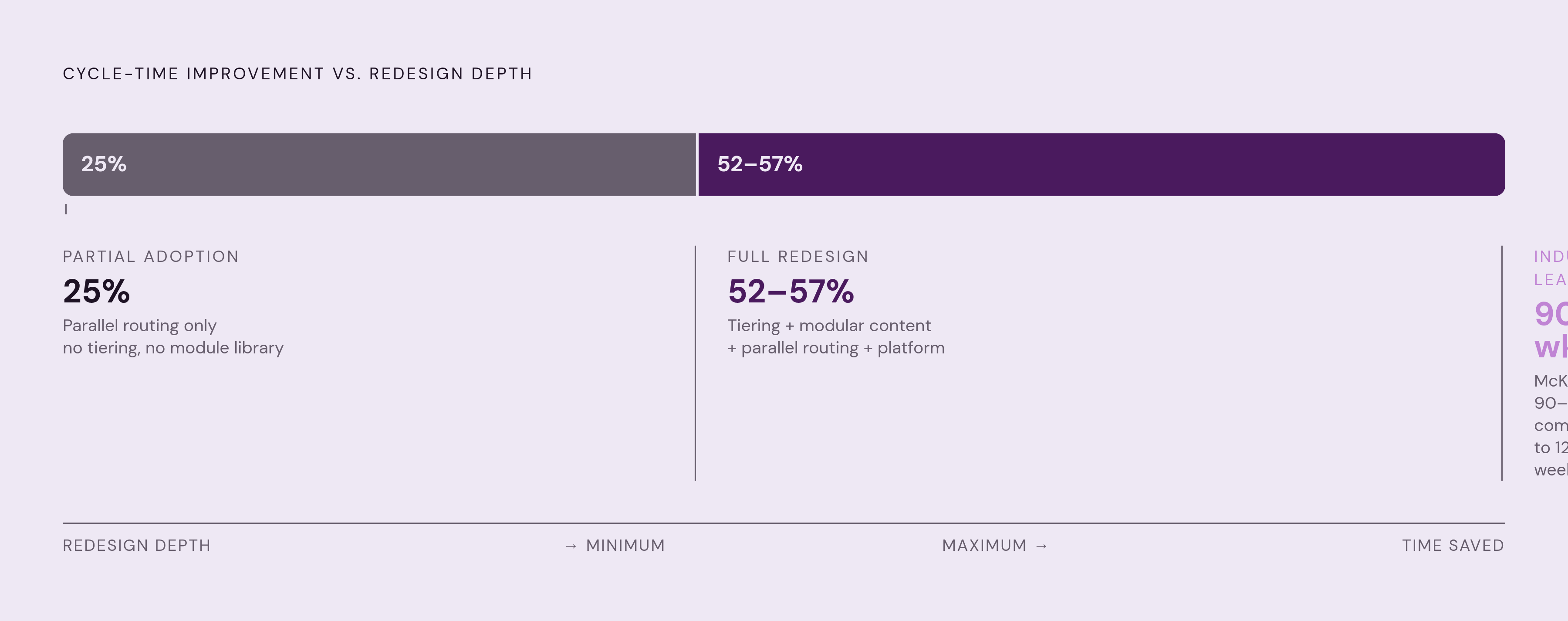
Veeva's Pulse Metrics from 2024 show a 57% reduction in review cycle times among optimized deployments, a figure that captures parallel review and modular content working together rather than isolating either one's contribution. A ProPharma case study documented a 52% faster MLR review timeline while keeping locally compliant reviews across multiple international markets, and that matters specifically because it shows the gain holding up under geographic complexity rather than in some tidy single-market scenario. The same Veeva customer data also shows a 55% reduction in time spent in MLR or PRC meetings and a 25% reduction in time spent on compliance procedures generally, numbers that track reviewer capacity freed up, not just calendar days shaved.
What should a reader take from a range running from 25% up to 57%? Roughly, it tracks how much of the workflow actually got redesigned. Partial adoption, parallel routing bolted on without tiering or a module library behind it, lands at the low end. Full structural redesign, tiering plus modular content plus parallel routing plus platform support, lands at the high end. None of these figures break down cleanly into which specific change produced which slice of the gain, and treating a single number as a guaranteed outcome is the fastest way to set a project up to disappoint someone in a steering committee meeting.
The coordination disciplines that determine whether parallel review holds up under compliance scrutiny
Regulators and internal audit functions want a legitimate thing here: a clear record of who reviewed what, what got flagged, and how conflicting opinions got resolved. Sequential review answers that almost by accident, since the linear handoff creates its own paper trail. Parallel review has to build that record on purpose, or it ends up looking like three people marked up the same document with no record of whose comment prevailed and why.
That means timestamped annotations from each reviewer, visible together in a single version history rather than scattered across three separate files. It means a documented reconciliation step: not just a note that a conflict got resolved, but a record of how, and by whom. And it means clear signatory authority, spelled out ahead of time, on which function has final sign-off for which type of claim, so nobody's litigating that question in the middle of a launch deadline.
Submission quality feeds directly into all of this. Incomplete submissions entering the queue are consistently the biggest driver of extended cycles and rework, which means pre-submission checklists and automated pre-clearance checks are doing compliance work as much as speed work, even though budget conversations usually file them under "efficiency."
Escalation protocols matter too. A parallel system needs a defined path for surfacing disagreements that can't get resolved at the reviewer level, so an unresolved tension between Medical and Legal doesn't quietly stall the queue for two weeks while everyone hopes someone else deals with it. And reviewer capacity deserves ongoing attention as a leading indicator, not an afterthought. Content volume outpacing reviewer bandwidth is a documented delay driver on its own; tiering and modular content ease the pressure, but someone still has to actively track reviewer load, because a backlog at one point in the system can stall everything else no matter how efficient the parallel tracks are elsewhere.
Here's the part that tends to get glossed over: sequential review culture is deeply embedded in a lot of organizations, and moving off it takes more than a new software license. It takes explicit role clarity, reconciliation habits that get trained and practiced until they're automatic, and leadership willing to say out loud that the old linear checkpoint isn't coming back. The process change is at least as big a lift as the technology change. Treating it as the smaller one is how pilot programs quietly die around month six.
Where content strategy and production tooling intersect with MLR readiness
Everything upstream of submission determines how smoothly a piece moves through MLR, whichever workflow model it lands in. A brief that references approved claims clearly, that scopes the piece against a known messaging architecture, enters the queue with far fewer unresolvable issues than one assembled on guesswork and good intentions.
Content built around a defined claims hierarchy and a known audience tier is easier to sort into the right risk tier, easier to build from modular components, and easier for Medical, Legal, and Regulatory to review without three rounds of back-and-forth over something that should've been settled at the brief stage. AI-assisted drafting tools that build brand guidelines, approved claims, and safety language directly into the drafting process cut down the volume of editorial issues that ever reach a reviewer's desk in the first place. The Quick Check Agent model, screening before submission, is the platform-side version of this idea; AI-assisted drafting during content creation is the upstream equivalent, catching the same category of problem earlier and cheaper.
Marketing teams that own their content strategy and production directly, instead of routing every brief through a slow external agency relationship, keep tighter control over what enters the MLR queue and can iterate faster when something comes back flagged. Speed and quality stop competing once production is built around MLR requirements from the brief stage onward. The bottleneck moves from review to drafting quality, a solvable problem given the right mix of human editorial judgment and AI assistance, rather than a permanent tax on getting content out the door.
Practically, that means MLR-ready production, modular libraries, approved claims management, pre-submission checklists, deserves the same attention as the review workflow itself. They're two halves of the same system, and neither one delivers its full value until the other is doing its job too.