Global Modular Content Frameworks in Multinational Drug Launches
Modular content frameworks cut drug launch delays by pre-approving reusable pieces.

Nearly two-thirds of new medicine launches miss pre-launch revenue goals. The science is rarely at fault: multinational launches need content and compliance work that buckles under the load of twelve markets all together, and that failure runs up a bigger bill than any one regulatory wait.
Three breakdown modes combine to cause this. Fragmentation in regulations leads the list. With FDA and EMA, plus every local regulator, what each promotional material piece can claim and how it must appear changes, so each asset approved in one market may prove inadmissible elsewhere. A bottleneck in MLR follows. Under traditional medical, regulatory, and legal checks, every asset gets handled from scratch, regardless of how much of its content already cleared somewhere else. Veeva says the typical time for fresh biopharma content to reach the market is three weeks: six days in draft, plus 15 in MLR review. Then comes localization debt. The simple step is Translation. Visual layout, cultural feel, and how a local healthcare system's rules work each call for their own adaptation, but any change to a global asset must ripple through every local copy built off it.
These issues don't stand alone. As regulatory fragmentation grows, so does the amount of MLR work. As MLR volume multiplies, localization work piles higher. Asset-by-asset models for content, which pharma marketing teams mostly still use, aren’t made to handle and absorb the cascade. Most teams try a quick fix, like quicker approvals or more localization cash, addressing just a symptom. Real repair means a fix at the foundation, one modular content framework designed so compliance, local relevance, and pace stop competing.
What modular content actually means in a pharma context
Modular content turns a message into parts, each checked and approved by itself, later assembled for reuse in different platforms, groups, and markets. One module could be a clinical study overview, an approved point plus its safety statement, how the mechanism-of-action works, a graph of numbers, or an excerpt from approved prescribing details. Those modules are then built into HCP messages, MSL decks, event presentations, rep materials, and online tools.
This move seems tiny yet affects all downstream work: check a piece once and reuse that, rather than reviewing each finished asset like its parts are brand new.
This system generates content as needed, not pre-written copy left for pasting into a presentation. When a local team puts modules together into a market-specific asset, explicit boundaries govern what it may change, add, or cut. The approach is Modular content. The governance layer beneath is a modular content framework: a taxonomy, approval workflow, plus the metadata structure ensuring all of this scales to many markets at once.
Most teams aim AI at the incorrect layer when reshaping how this gets made. Veeva's December 2025 launch of Veeva AI Agents introduced tools, among them a Quick Check Agent and a Content Agent, aimed at cutting manual effort out of MLR. But expecting AI to repair a flawed content model solves the wrong issue entirely. AI makes a good system faster. Threw onto a broken setup, it churns out more content that goes unchecked, quick.
How the pre-approval logic cuts through the MLR bottleneck
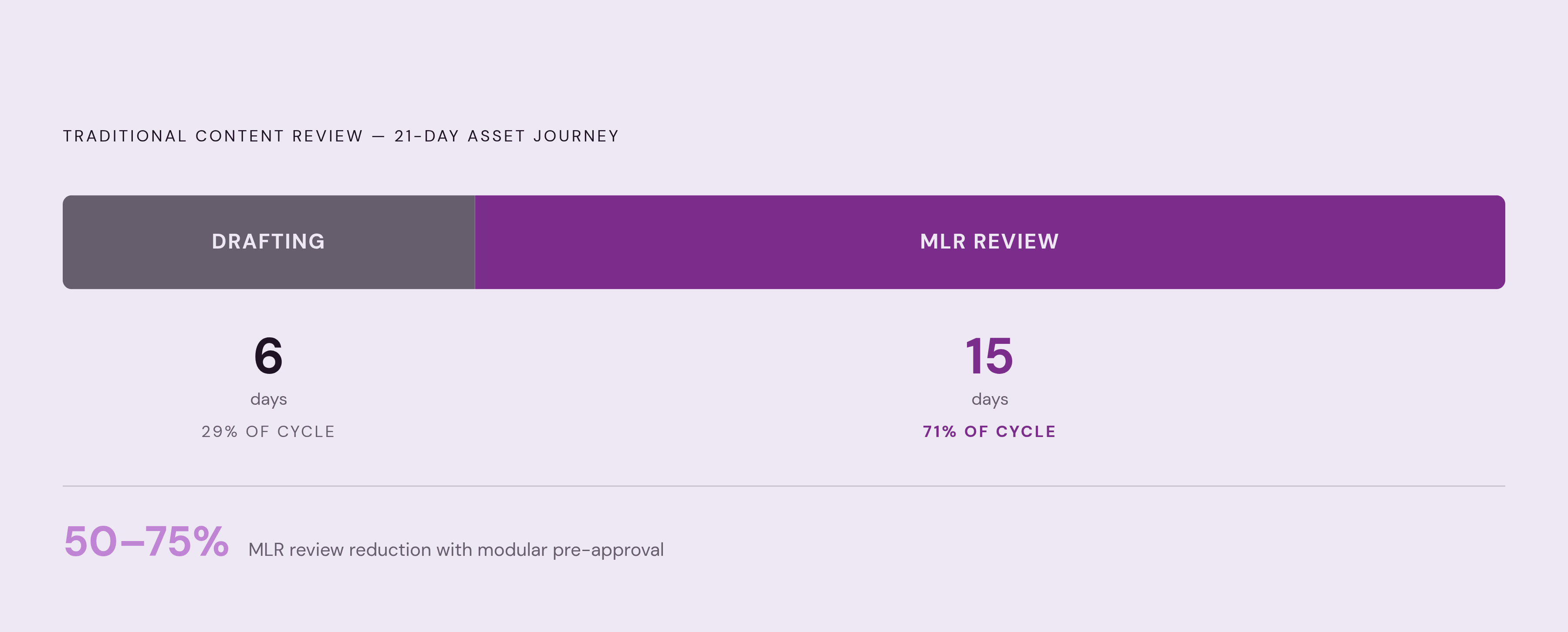
Finished assets get traditional MLR reviews. Each module gets its own MLR review. This is the whole shift, and the reason the time savings aren't just cosmetic.
After building each asset out of modules holding prior approval, our MLR team just reviews fresh pieces: how they fit together, their context, plus any local content. The review team need not revisit the clinical claim or safety language buried inside, since prior approval already covers those pieces. By scaling how hard people check each asset based on its reused content compared to fresh material, Veeva's tier-based model cuts approval time by 50 to 75%. Centralizing assets into a single content system, where medical, legal, plus regulatory teams share one real-time picture, can cut time-to-approved-content by up to 75% alone.
Agentic AI sits over that instead of taking its place. Auto-linking approved statements with one centralized evidence library cuts manual verification work by about 90% versus checking each one yourself. Compliance pre-checks plus flagging, previously entirely manual work buried inside any multi-stage MLR workflow, proceed without anyone triggering each one. Still, all of it fails to replace the governance work needed to create solid modules from the start.
Plenty of teams miss that trap and pay for it. Faster work doesn't happen by itself; it comes entirely from how well the modules are made. If a module is written loosely, or without enough specificity for the reviewer to approve fast, downstream friction eats those time savings. Shorter MLR time stands out as the clearest payoff from one modular setup, yet not its deepest. The real payoff comes from how a framework that's well-built keeps regulatory compliance right in each market at the same time.
Building regulatory compliance into the framework architecture from the start
Going global with a launch won't flatten the regulatory burden. FDA, EMA, and local regulators govern promotional material uniquely: distinct content standards, formats, approval processes, submission demands. A multinational framework must bake compliance into every module from the start, not fix it afterward. Every module holds metadata flagging which regions have signed off on it and how it's allowed to be deployed there.
On the ground, this means a centralized platform: one system that standardizes the workflow yet still covers each region's regulatory needs, with full trails, role-based access, and built-in version history. Linking a promotional content system (such as Veeva PromoMats) with a regulatory platform (Veeva RIM) lets teams generate submission-ready compliance packages from approved assets, provided the workflows are properly configured and triggered.
What this link eliminates must be stated with no evasion. Nobody re-enters the same information in disconnected tools. You won't end up submitting any asset previously superseded by a newer one. No wait on the post-marketing submission because a regulatory team used a version other than what marketing sent.
Any group of team members doing Retrofitting compliance later regrets the choice; such efforts never work, full stop. Compliance must be built into each framework's taxonomy, every metadata structure, and all approval workflows before one module is made. Fixing it once a hundred modules already exist is expensive, and it's exactly where things get missed. With that regulatory layer ready, localization becomes the issue for a multinational launch, and it takes more work than many teams expect.
What genuine localization requires beyond translation
"Translate the global asset" is the phrase that gets used, and it undersells the actual job by a wide margin. Translation only counts as the entry fee, and when teams quit there, their local assets quietly drift from the science before twelve months pass.
Language is just the starting layer. Leaflets for patients, labels, ICFs, write-ups for pharmacovigilance, all the clinical study documentation, plus promotional material and everything else, must appear in each market's local language wherever a treatment ships, full stop. Cultural framing comes next: messaging must fit how people in any given market want to be addressed, plus how each local healthcare system gets structured, so it works. There's also a separate layer for Clinical context. Usual practice, prescribing patterns, and patient baseline knowledge shift from market to market, meaning HCP material written for one European clinical route can feel off, or irrelevant somewhere else. Visual elements get missed more than anything above: labels still in another language require a graphics person to fix them, and translation workflows also routinely leave out this work.
The cascade problem is what really wrecks everything. Change the global module once, and each localized asset built on it must change too. Your framework needs Global-to-local traceability from the start, since going through it manually for every market later falls apart, and when teams do that, plenty of local assets quietly use outdated science until a regulator or auditor spots it.
Most patient growth will come from emerging markets including India, Indonesia, and Brazil, where people rarely use English as their main language. Going forward, global launches will only demand more localization volume. Those framework's guardrails have to spell out exactly what any local team may change or add or cut, keeping scientific facts in the material intact while letting teams do their work. The success of that approach rests fully on how the global module library was built.
How global module libraries are structured and governed
The pillars plus the scientific story come first, forming key claims that all content within each market must link to, no matter who sees it or where it appears. These are not marketing taglines. The modules are built on this clinical and scientific base.
A proper taxonomy comes next for modules. Grouped by claim, backing data, safety statement, visual, and storyline; by HCP, patient, payer, and MSL; by email, congress, and digital; and by market authorization standing. The module carries metadata too: the jurisdictions that approved it, under what rules, its expiry date and re-review timing, which parts can change by market and how far, plus the localized assets coming off it, so any change cascades as it should, not silently turning stale downstream.
Local teams should help build the framework before launch, rather than after the taxonomy is set. Most global teams get this sequencing wrong: what doctors, payers, and the people being treated in each market share reveals the clinical gaps, format preferences, and cultural sensitivities to build into the taxonomy up front, not patch afterward as one-off exceptions no one has time to fix.
Governance also covers which people may create each module, which team approves it, which people can modify it in-market, and who owns the core library. Permission by role is what truly gives local teams self-serve freedom without threatening the regulatory paperwork, rather than some bureaucratic afterthought bolted into the system. Here’s the clear sign it’s effective: if the local team is able to assemble one compliant asset using approved modules with no triggering of full MLR checks for each adaptation, then that framework is on track. If they fail, that bottleneck stays. The bottleneck has only gone out of the global team and into local hands, a bigger problem because the people measuring launch cannot see it.
Everything rests on a well-governed library. Still, any framework people don't adopt or track does no good. So the real test is this: can you tell that it does the job?
Measuring whether the framework is actually working
Three numbers count most, while teams measuring just one are missing the point.
Reuse rate: how much asset content is pulled from the module library instead of written from scratch. A rising reuse rate shows most clearly the library is doing its job. Self-service percentage: the share local teams build alone, with no global team stepping in to help, showing if that governance model is enabling them or just putting on another friction layer. First-pass approval rate shows when the assembled asset clears MLR at initial submission, with zero revisions. When that score drops, module issues are surfacing past the point where you can fix them cheaply.
The order teams move in counts for more than they think, and botching it is the top reason a rollout stalls. Only after reuse has demonstrably increased should the framework move into another medium. Expanding to many platforms quickly drags down all three numbers together, and teams pushing for reach before showing reuse usually wind up rebuilding that rollout afterward, spending more than if they held off.
This can’t work with spreadsheets or manual checks once any library spans many markets and regions. Tracking breaks down completely unless a centralized platform, the one that manages all modules, also shows how people really use them.
When it is working, reuse rate climbs, self-service percentage rises, the rate for first-pass approval goes up, and each market sees time-to-market fall in step. A framework that's off track shows itself when those numbers stop moving together. One problem needs naming: reuse rate may get gamed. If any module gets written too vague to require adaptation, it looks like it's reused a lot, but this isn't success. The content has no substance, and when teams hunt that metric while ignoring specificity, they build a library full of those pieces. Track Reuse and specificity together, or the metric fools you.
The AI visibility layer multinational content teams have not yet built for
How a Framework works only matters to staff. Multinational launches must compete for visibility through a space that frameworks built back then never planned for: an AI handling patient queries itself, with no marketing team involved.
Spectrum Science reports ChatGPT gets 230 million health-related queries every seven days, and that volume quickly dwarfs what the whole HCP plus patient footprint looks like for most teams, while not one carries any promotional guardrail from drug companies. IQVIA reports that 54% of HCPs now use generative AI in clinical contexts: querying medicine details, summarizing study results, testing guideline alignment with a model's answer. Verified doctors ran 18 million queries on OpenEvidence each month.
Three disciplines now try answering this, while many pharma content teams still have not built around them. GEO, short for Generative Engine Optimization, involves structuring content so that ChatGPT plus Gemini and Claude reliably use it to describe the medicine accurately: true statements, right citations, keeping evenhanded coverage intact. AEO, Optimization for Answer Engine, deals with zero-click results, snippets, boxes for People Also Ask, and answers that users get without visiting the company’s page. The internal-facing counterpart is LLMO, Large Language Model Optimization: getting enterprise-owned information, study outcomes, labels, and SOPs ready so a firm's proprietary AI can retrieve everything accurately.
GEO replaces nothing about classic SEO, and calling it the end of SEO misreads what the figures show. Codeless.io's analysis puts Google's traffic volume near 373x ChatGPT's. GEO works as one more channel next to SEO, governed by its own logic, and companies that pit them against each other as competing aims will keep underinvesting on each.
What we've built so far is exactly why this point counts. A structured, sourced, claim-linked module library, built to meet regulatory compliance, is hardly coincidentally the content an AI system is able to accurately parse and cite. The framework built for clearing MLR bottlenecks alongside localization debt happens to be what any launch team must have to appear inside an answer engine. Teams who got it right for a single use are already set up for the other, noticed or not, and those still using asset-by-asset content models trail on a double gap, not just one.