AI-Assisted Claims Tagging in Promotional Content Libraries
Regulators now penalize unsubstantiated AI marketing claims with rising enforcement and fines.

What regulators demand from promotional claims today, with enforcement growing sharper
The baseline is unchanged: FTC rules say any real claim must have competent proof and solid evidence behind each one, assembled early instead of scrambled later. Both the FDA and the FTC bring their own approach to this for US medical and efficacy claims. EU claims fall to EMA, while UK ones go to ASA. These rules aren't recent. The difference now is how frequently regulators actually look, and the price of getting flagged. Under the 2025 update, each offense costs a maximum of $53,088, and roughly 670 marketers got notices from the FTC.
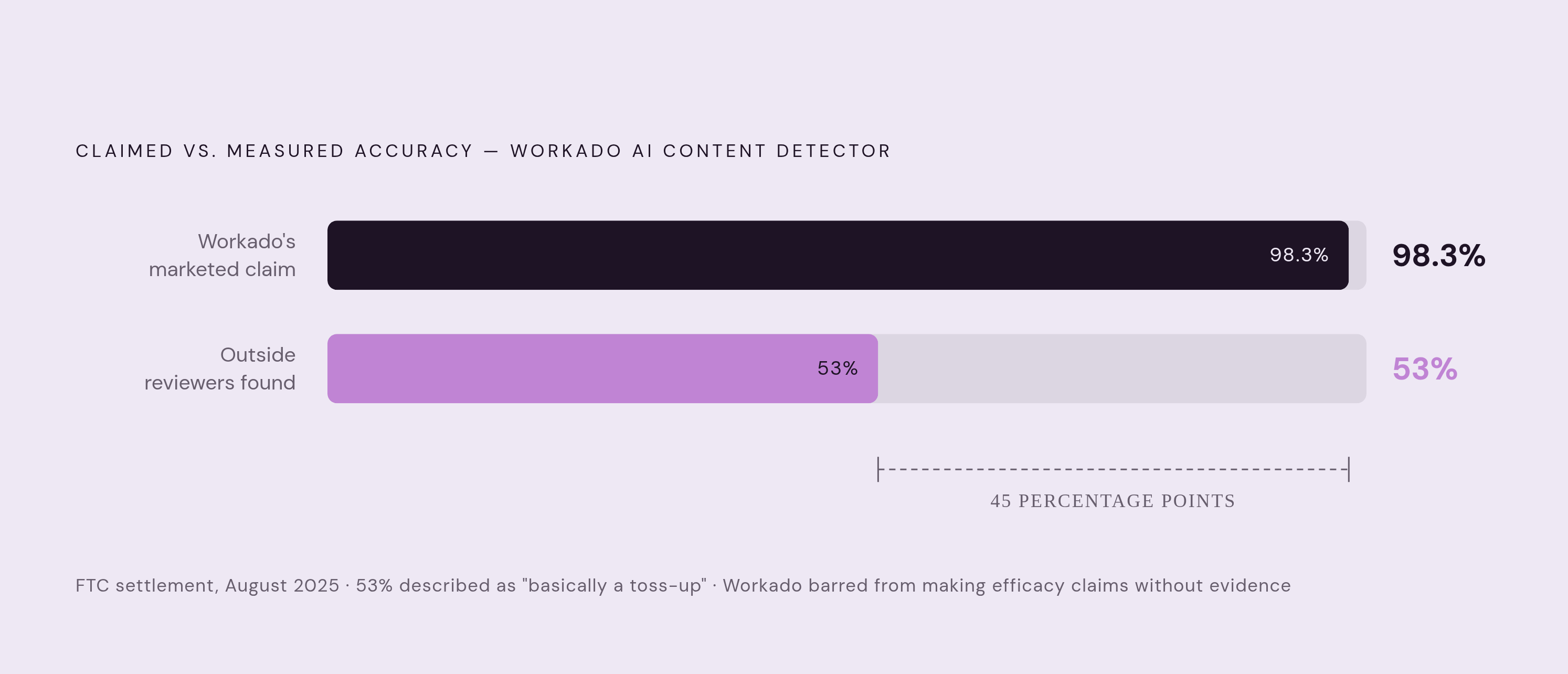
The Workado story points to the fallout when evidence falls behind a claim, so the figures warrant a fresh look. Workado marketed the AI Content Detector, saying it was 98.3% accurate in checking people's words against AI-generated text. According to the FTC's filing, outside reviews found general-purpose content scored 53%, basically a toss-up, so that mismatch with their claim drove the entire lawsuit. In August 2025, the FTC granted approval to a settlement barring Workado from making efficacy claims regarding its AI tools absent evidence behind them. Anyone making performance claims on any AI-powered system sits beneath the same rule, no matter where that claim appears.
That case fits into a broader 2025 enforcement push regulators have launched against what they term AI-washing. Regulators have flagged recurring issues in AI-washing cases, including claims lacking clear substantiation. Multiple sectors, including healthcare and financial services, have seen firms called out for AI-washing. The categories matter less than the shift itself, the FTC moved from writing guidance to actively investigating, across all of them, in the same calendar year.
The EU layers another demand above substantiation, requiring disclosure alongside any proof. The EU AI Act began taking effect in February 2025, with transparency obligations for general-purpose AI models in force by August 2025 and content-labeling requirements under Article 50 arriving in August 2026. The labeling rule applies to deepfakes in particular: realistic images and audio resembling actual persons, locations, or things. Regular promotional copy stays largely exempt, yet the trend is clear. Enacted in September 2024, California's AI Transparency Act mandates "clear, conspicuous" disclosure of AI-generated audio, video, and images. Colorado's AI Act kicks in on January 1, 2027 forcing risk management plus disclosure on deployers of high-risk AI, so marketing teams now have a hard date for making claims audit-ready instead of some vague feeling they should.
Rather than holding out for regulators, these platforms now enforce their own policies. YouTube has required disclosure of "realistic altered or synthetic content" since March 2024, with enforcement active since early 2025; skip it and a creator risks a strike or demonetization. Meta applies C2PA Content Credentials with IPTC rules, letting it auto-detect plus tag AI-generated images made by tools like Adobe Firefly, DALL-E 3, or Microsoft Designer, though content from non-compliant software still calls for hands-on disclosure. TikTok has its own labeling rule covering audio, realistic AI images, and filmed clips, while scripts, captions, and other AI-assisted text remain exempt. Meta reported a high volume of labeled content views across Facebook during a 29-day period in October 2024. Marketing teams mostly rely on manual tagging, even as platforms handle hundreds of millions of items.
AI claims tagging spans asset ingestion through governed results.
Once set up, the process runs by rule, and it should not need a person deciding each time. Asset types include a blog post, a product listing, a transcript, a PDF, something with text baked into it. The software scans what's written, how it flows, and its mood to find entities: company marks, product titles, certifications, places. The system then predicts tags, subject, claim kind, risk level, jurisdiction, plus suitable channels. A person reviews those surfaced tags to accept, change, or drop them, while the app logs how sure that model's prediction was alongside their final pick.
Every tagged claim's metadata is what keeps it controllable down the line. Every well-built entry includes approved claim text, where it came from (a trial, a package statement, some official advice), an owner assigned to it, jurisdiction tags, audience tags per platform, its risk level, the version number and expiry date, plus ties to social variants, short-form, and long-form. Once AI drafts copy, the metadata controls downstream output: when any claim gets tagged plus sourced, an LLM can't paraphrase it into text lacking evidence. Live metadata follows lineage as it happens, and when a reference paper is revised or withdrawn, each asset tied to it is flagged on its own.
The failure points count for more than the success stories. Tagging performs strongest across big, matching collections that use steady naming plus text-heavy assets. Hand it a folder of UUID-titled assets or ones numbered in sequence, though, and there's no signal to work from; it guesses anyway, and guesses confidently. This is the real danger with LLMs here: they generate plausible-sounding text even when the asset doesn't back it up. For any regulated field, one confidently false tag hurts more than none, because a person downstream trusts it without review. A person must check every claim that's high-risk, period. AI handles volume; humans make the call where an error actually has consequences.
AI metadata tagging, when done correctly, can reduce tagging work by up to 70%. Pharma teams usually handle this using platforms such as Veeva PromoMats, where a Claims Management module plus auto-linking keep sources attached to reused copy. Elsewhere, teams work with options such as Sitecore Content Hub, which handles AI-assisted DAM tagging and localized versions that maintain original links. Teams with limited resources may use spreadsheet-based tools for prompt-driven tagging to reduce costs. It doesn't reduce the chance of tagging something badly.
Building a modular claims library: the structural layer that makes tagging durable
Tagging shows people which claims exist already inside the library. It won't show what new claims ought to be added later, which is another task. That’s what a claims library is for: a factsheet for each product, with every approved certification, claim, and formulation, so AI-assisted copy stops drifting from approved wording.
In that library, a well-built entry includes the claim text (approved wording only), where it came from, an owner tasked with keeping the entry current and renewing the entry, jurisdiction tags applied, tags covering audience and outlet, plus a risk level and expiry date bearing its version number, alongside short-form and long-form pieces, plus social variants.
Putting one together doesn't take a full quarter. Treating this like an IT job lasting year-long makes most teams stall before going live, so use a four-week timeline. Start with an audit of the leading claims from the previous twelve months, capturing expiry, owner, plus jurisdiction per claim, defining module categories (base claim, evidence note, warning wording, fair-balance text, social variant), then select a home for it all. In the second seven days, set up tags covering product, audience, medium, area, risk, plus lifecycle. Put together a checklist scaled to each risk level, then lay out duties: marketing drafts, doctors or lawyers approve high-risk claims, compliance tests it against the policy rules. Third round: switch on auto-linking and claims management in the selected software, activate alerts whenever a reference shifts so reliant assets come to light on their own, and teach the AI that handles drafting to draw on the library before anything else, refusing any unapproved claim that lacks a cited reference. In the last stretch: test a product in both channels, measure first-pass approval rate plus policy flags, compare time-to-approval with baseline, then grow.
It won't succeed if marketing alone runs it. Treating it like that is the error that ends these efforts out of sight, not loudly, because no one notices the library rotting before a review arrives. Compliance, IT, and the legal team have to see the same claims, audit records, and linked evidence packs from one shared record. Without cross-functional teams sharing responsibility, claims expire with nobody renewing those entries. Jurisdiction tags turn stale, and the record becomes useless.
A few figures show if the library is actually sound. In-library rate shows how many fresh assets use approved modules instead of getting made from nothing. The First-pass approval rate needs to rise as months pass, while policy flags per 100 assets fall. Global-to-local reuse shows how frequently each module is reused in new regions rather than rewritten from zero. Expiry checks how many claims still have an up-to-date, accepted reference attached, and this number decaying makes a clean-looking dashboard hide a setup that is actually breaking.
Everything depends on solid information. Gartner predicts that 60% of AI efforts will be dropped by 2026 because what feeds them is not AI-ready. The solution requires improved metadata, not extra information. A sourced, tagged claims library plugs that hole for real, not just something a deck runs through every three months.
How tagged claims affect visibility within AI-generated results
AI tools are now a genuine way people find things, not a passing trend. Over 71% of Americans turn to AI for research or to look into a company before spending money. Similarweb's Generative AI Landscape study showed AI platforms pulled in roughly 770.7 million referral hits each month globally from June 2025 through May 2026, climbing 117.4% from the prior twelve months. Even when not tagged, AI tools retrieve and synthesize material, then cite content along with any claims inside that content.
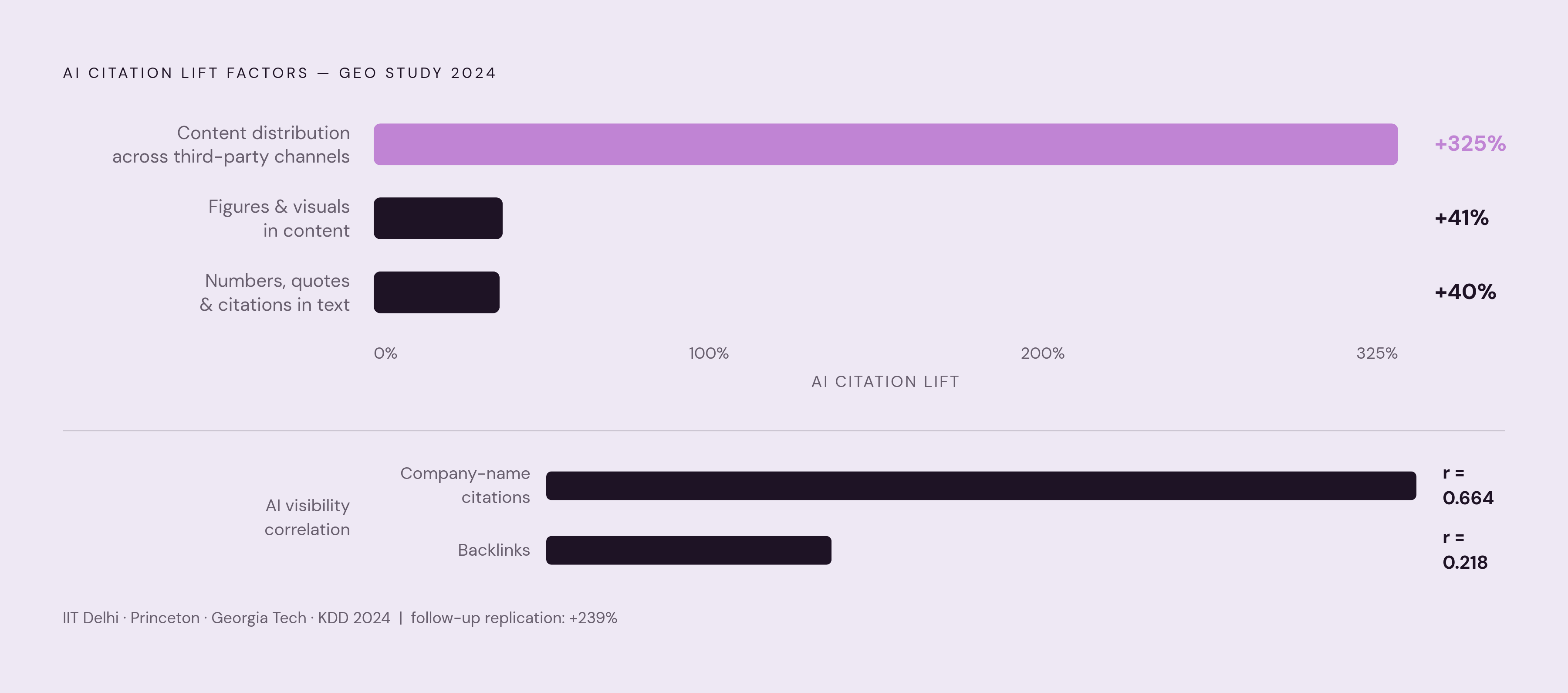
Claim strength and the rate at which AI systems cite any content go hand in hand, and that's no coincidence. Research from IIT Delhi, Princeton, plus Georgia Tech (their GEO study, KDD 2024) found content using numbers alongside quotations and citations gets picked as much as 40% more often, while figures on their own raise AI visibility 41%. A claim tagged by origin, with jurisdiction plus evidence, structurally fits the content AI prefers to cite. Both compliance Tagging and AI visibility Tagging focus on identical content. Teams treating these as distinct workstreams end up duplicating work for no reason.
That GEO research found company name citations correlate to AI visibility roughly 3x more than backlinks (0.664 compared with 0.218). Putting content in many third-party places, instead of leaving it boxed in as confined to channels, raised AI citations as much as 325% during the research; 239% was typical in later follow-up. Because each claim version brings its evidence along when republished, a governed, sourced claims library enables that kind of spread to work.
Ungoverned claims have a hidden price most people miss, and the damage is real today, not a distant worry. AI only ever draws on and may cite what sits inside the library, and it treats sourced work and guesswork alike. If a missing-label untagged claim shows up inside AI-generated copy, there's no source available to be traced back through, creating compliance and credibility issues as soon as someone challenges it. Gartner expects a substantial share of corporate choices to get augmented or automated through AI tools ahead, making what a claims library holds matter more as those programs start writing and signing off on claims.
Citation presence is now a KPI sitting above mere visits. Agencies and brands watching only click counts are looking at the wrong thing. Similarweb's research found AI suggestions make people several times as inclined to reach a brand via branded queries instead of a referral source, so citation presence counts for more of the funnel than clicks referred by AI do. AI-referred buyers made purchases at 42% better rates versus non-AI users during March 2026. That citation number grows when a claims library creates citable, well-sourced content feeds, and that is what actually lifts sales.
What this means for agencies
Agencies are where all of this comes together. They write the claims, push them out through more channels than anyone, and take the blame when flagged status hits a client's promotional copy. A modular claims library and claims tagging are both becoming part of the media product that an agency actually sells. These things now factor into what an agency really markets on the media side. If any agency can give a brand its audit-ready claims library plus proof, named people, with jurisdiction tags attached for each claim, it provides work the regulator respects, which AI cites more.
Agencies that still run claims tagging like an annual compliance check will be the ones stuck answering to a client or an industry watchdog over an asset put out eighteen months earlier that traces back to nothing at all. Only agencies that created their library ahead of time will have a response when that talk happens, no matter how prepared they feel.
Sources
- Labeling AI Content | Transparency Center
- Build a Pre-Approved Claims Library by 2026
- AI Disclosure Rules by Platform: YouTube, Instagram/Facebook, and TikTok Labeling Guide
- What the FTC, FDA, SEC, and EU AI Act are telling us about AI content in 2026
- FTC Brings Dozen AI-Washing Enforcement Cases in 2025, Targeting Overstated AI Claims
- intuitionlabs.ai