Patient Support Program Design for Adherence in Chronic Disease
Weak enrollment and one-way messaging quietly exclude the patients who need support most.
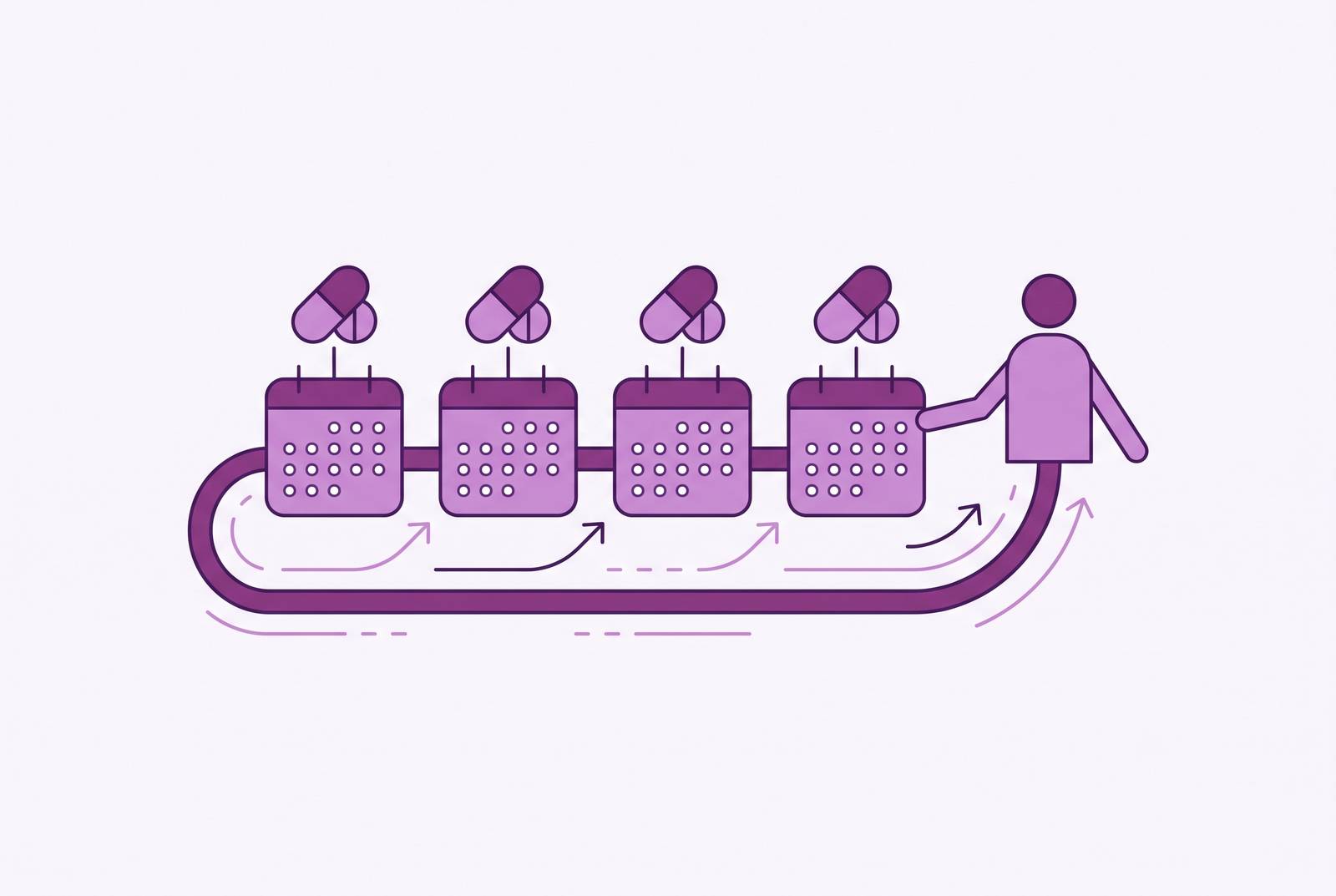
When people skip their prescriptions, it drains over $300 billion from health budgets annually and leads to 125,000 preventable fatalities. It's not about willpower. Most patients receive medication orders, then must navigate expenses, questions, and side effects within a system built around prescribe, not support. Roughly 26% to 63% of those living with a chronic condition skip what's prescribed for them, and roughly one in five prescriptions goes without being picked up. This is a design flaw, and the pharmaceutical sector built the PSP (patient support program) to address it, unevenly, based on execution quality.
What a patient support program is expected to do
A PSP is a group of supports, generally covered by the pharmaceutical company, designed to get a patient started on therapy, make it easier to pay for, and ensure they stay on it until the prescriber says otherwise. It seems easy until you list the real work: getting people signed up, pushing through coverage for them, finding money to help pay, keeping pills on time with texts and a nurse calling in, explaining their illness, and being there when things go wrong.
Cutting one of these pillars doesn't just weaken the program, it kills it. Cutting financial help makes patients ration their doses. Cutting support causes a patient to quit on their own when the first side effect hits. Manufacturers figured this out, so PSPs get built into rollouts right away, mostly for oncology and immunology along with rare conditions where treatments carry steep prices, regimens are hard to follow, and a patient who quits early means serious financial damage. The numbers back this up: PSPs drew a substantial sum worldwide during 2024, and forecasts see yearly compounding hitting 17.1% out to 2034, following the industry's push into high-cost therapies and specialty care.
Enrollment architecture: how patients enter the program determines whether they stay
Enrollment is often where it all falls apart. If a patient gets stuck during onboarding, the rest of the program is wasted, even if the nurse support and co-pay help sound great. A slip at enrollment leaves every layer above it as just theory.
The same failure modes mark launches. Intake still depends on printed sheets and call centers in many places. It leads to more forms, more callbacks, and more moments where a patient can drop out before anything begins. Prior authorization creates a dead zone of its own, the gap from when medication is prescribed to when the patient actually gets the first treatment, and many drift during that wait. Other times the failure gets dumber than that: patients don't even know the program is there.
The idea is simple, even when doing it is tough. An online form where someone signs up on their own is always better than a phone center. Enrollment triggered during prescribing closes that first dead zone by getting the program in front of the patient before a gap opens. Folding verification into onboarding catches coverage gaps before a patient quits for that reason.
Enrollment design is more than a logistics concern. Enrollment design says who the program actually serves. High-friction intake quietly filters out the patients most in need of support: those on lower incomes, patients with little health literacy, and people who won’t install an app just to reach a nurse. Friction built into intake causes the program to serve the patients who can most easily do without it.
Barrier-targeting: matching program services to the specific reasons patients stop
Non-adherence means several unrelated problems can lead to the same result, a patient stops taking the medication, and each needs a different fix. Several unrelated problems end the same way, with the patient stopping treatment, and each calls for a different fix.
Money is one barrier: patients miss or divide doses to make medication last, so support includes co-pay help, patient assistance options, and links to financial foundations. Complexity is another, bigger than most people assume: roughly half of all filled prescriptions get taken incorrectly, wrong timing, wrong dose, wrong duration. Misunderstanding about a side effect can lead patients to quietly give up instead of making a call, which is precisely where support earns its keep. Logistics also count: missed refills, no way to the pharmacy, coordination that breaks down between check-ins. Motivational drift is another problem: patients follow the plan at first but fade, and that's the biggest long-term risk for any chronic therapy.
In the first year, 50% to 60% of patients with chronic conditions skip doses, take too much or too little, or quit. That first year is where a well-targeted intervention pays off the most, since it's where the largest share of preventable drop-off happens.
Handing financial assistance to a patient worried about side effects won't help. A disease-education packet handed to a patient who can't pay the co-pay won't help either. Barrier assessment needs to happen first, not after support, and the prescribing system often doesn't see these problems: they sit in the gap between pharmacy and what actually goes on at home. A PSP that only pushes out alerts won't spot any of this. One built around genuine back-and-forth follow-ups may notice trouble before that patient disappears.
Communication channel selection and the populations most likely to fall through the gaps
Picking an app, portal, text, or phone call determines which patients are functionally excluded from the program before anything is even sent.
The groups tied to the biggest part of long-term illness spending, aged people, those with less money, those who know little English, and those outside cities, are often missed by web tools. Text messaging gets through to them, because almost any phone owner can get an SMS, whatever their literacy level or location. That alone should end the argument more than it does.
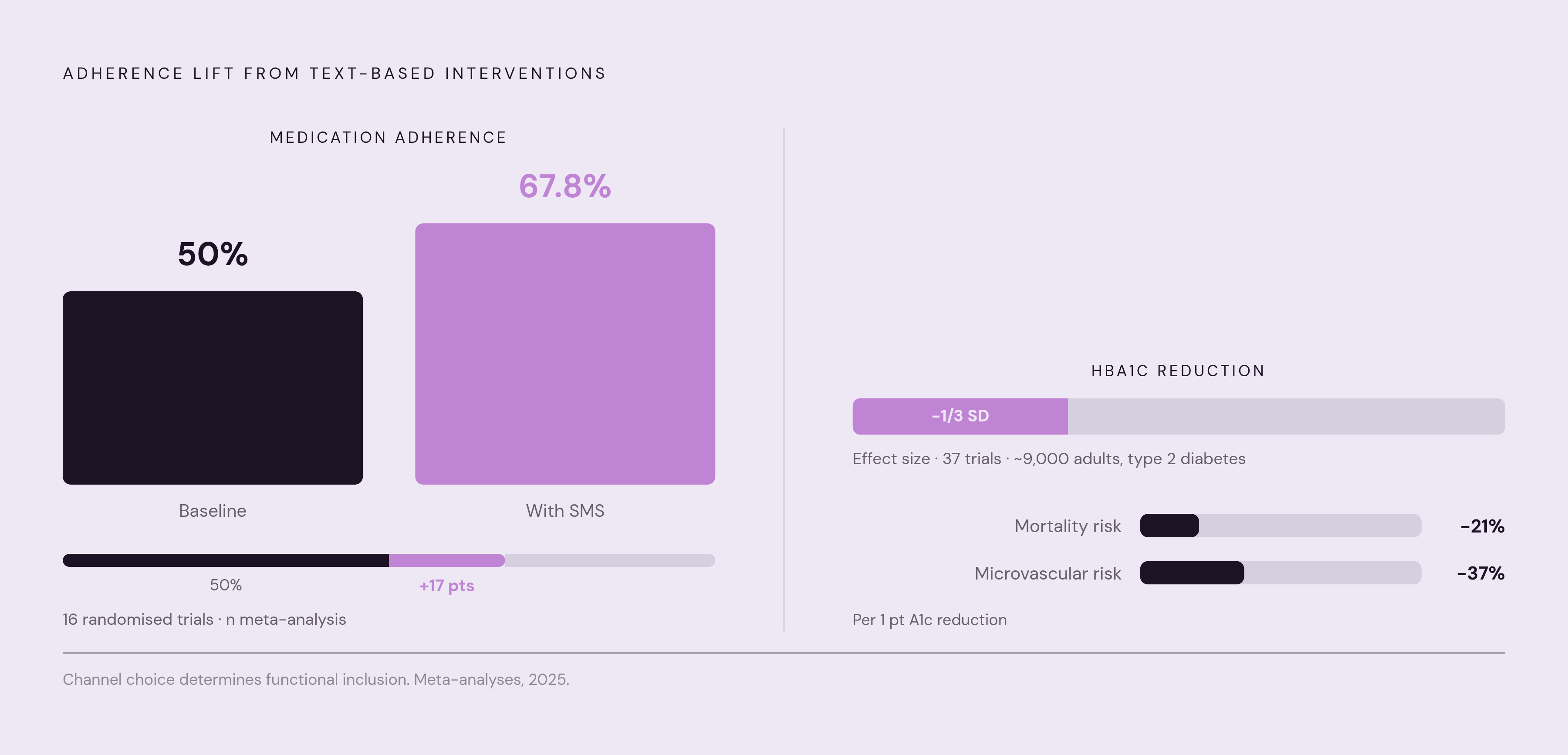
The case is strong. One meta-analysis of 16 randomized studies showed text messaging roughly doubled patients' chances of medication adherence, raising adherence from a 50% baseline up to 67.8%, an increase of 17 points in people with various chronic conditions. Another 2025 meta-analysis, across 37 trials and just under 9,000 adults living with type 2 diabetes, reported that text-based behavioral interventions reduced HbA1c about one-third of a deviation, while one percentage-point less A1c has been tied to mortality falling by 21% and microvascular complications by 37%.
But that all falls apart if communication flows in just one direction. A mass text sent by schedule only makes the nudge louder. When a two-way system gives the patient a way to answer, it becomes a way to watch them, and that happened, concretely, at the Hackensack Meridian Mountainside Medical Center: a patient responded to a check-in text, revealing they had not filled their prescription due to cost concerns. That one response kicked off same-day help that no one-way alert could have surfaced.
Personalization depth as the reason generic programs lose patients over time
It’s one thing to get a patient enrolled and going. Holding their attention long-term is a separate, harder problem, and that's where most PSPs fall apart. Dropout happens a lot, often linked to fading drive or basic friction: a clunky app or a portal no one will open twice. Interventions have to be adaptive and low-burden, working around a patient's schedule, not making the patient work around the program's.
Many PSP tools were built with personalization too shallow to reflect how patients handle their own health, a design gap that can undermine long-term engagement. This is a design failure.
What actually helps adherence comes down to practical details. Outreach around a patient's refill cadence and own schedule, not when the program finds it easiest to communicate, counts for more than the actual wording of the communication. Writing in words the patient understands, not clinical shorthand, keeps directions usable. Flagging patients likely headed for drop-off for closer outreach before they stop answering, not after, catches the trouble while still fixable. Anticipating side effects at a given point in care, say the reactions many people get when starting adjuvant endocrine therapy, then handling them proactively works better than letting a patient quit on their own.
Co-design builds the workflows patients actually rely on by shaping the program with those facing it, not handing them a finished product. When clinicians and patients are actually shaping how the workflow gets built, the result is something patients stick with, not a finished product they tolerate.
Structural Changes AI Enables in PSP Design
The old PSP relied on staff: call centers staffed by nurses and coordinators guiding patients through therapy, phone call by phone call. That approach is effective, but scaling it means spending more in direct proportion, since providing individualized care to ten thousand patients amounts to roughly ten thousand times the expense of treating one. AI's work isn't just cosmetic: it does the regular check-ins and personalization for thousands of people, which frees coordinators and clinicians to focus on the hard situations that actually call for a person.
Several deployments already demonstrate what that means in the real world. Sanofi's MyStar Connect program using an AI-driven platform increased adherence rates by 35% over traditional methods. Pfizer's oncology PSP applies ML to flag patients at risk of side effects, enabling proactive outreach so a patient won't quit therapy early, and the firm says this helped results and lowered spending. In July 2025, Accessa introduced OsteoAcces, an ADHAESIO adherence program for patients with osteoporosis on denosumab. Sidekick Health has a clinical study underway of a mobile care app for people with breast tumors on hormone-blocking treatment, tracking confidence and medication compliance, with findings due in June 2026.
The other big change is pace, and most underrate it. Some AI systems say they can launch a complete PSP, from enrollment validation through predictive adherence modeling and adverse event monitoring, on one system in two months or less. A human-led setup once took much longer, and this shifts the math for launches that previously couldn't support setting up a call center.
The value-based care context that makes PSP design a financial imperative, not just a clinical one
Under value-based terms, a payer or health system faces more than a clinical letdown when a patient quietly stops taking medication. That patient appears in the records as an ER run, a hospital stay, a metric that gets missed, and a cost someone further down the line has to cover. As much as a quarter of all hospitalizations each year trace back to medication non-adherence, and that number is what turns PSP design from a marketing add-on into a direct line item on the cost side of the ledger.
That should be enough to reframe the debate, though it still doesn't. A badly built PSP, featuring clunky enrollment, weak outreach, and zero barrier assessment, turns into a permanent drag, quietly generating failures that a value-based setup is meant to penalize. A well-built PSP keeps costs down as much as it serves patients. As the industry shifts to reward results over quantity, design details like sign-up, barrier assessment, outreach, and tailoring aren't just clinical extras anymore. They turn into how the costs actually get cut.