FDA Regulations on Patient Testimonials in Drug Advertising
Patient testimonials in drug ads must meet the same safety standards as official labeling.

The FDA doesn't control the emotional appeal of a patient testimonial. It regulates the claim within that emotion, and when a testimonial enters sponsored content, it must meet identical standards for risk-disclosure, fair balance, and truthfulness as official drug labeling. Marketers who think testimonials belong in an easier, softer kind of content are mistaken, and recent enforcement makes that clear. A section of the governing drug advertising law requires every prescription drug ad to carry "a true statement" of side effects, contraindications, and effectiveness, with no carve-out for a story told in the first person. Once a patient's words show up in marketing, the brand is on the hook for that content the same as for any claim drafted by its regulatory team, however natural the post looked at first.
Fair balance is the governing principle, set out in the statute governing drug advertising, and 21 CFR 202.1(e)(5)(ii) echoes it. Risk information has to be "comparable in depth and detail" to benefit information. Not briefer. Same size. Not tucked out of view while the claim gets the headline treatment.
FDA's rules spell out exactly when an ad breaks this standard. Per 202.1(e)(6), an ad is deceptive if it implies a drug carries lower or softer adverse reactions than what the substantial proof or substantial real-world data support. That standard applies just as much to a claims chart as it does to a patient on camera saying "I had no side effects at all." Once that line airs in a sponsored ad, it functions as a safety claim, and it has to clear the same evidentiary bar as any other safety claim in the regulatory file.
Under the FD&C Act, 201(n) together with 502(n), paired alongside 202.1(e)(5)(iii) and (i), mean ads must not omit key details their messaging implies. If a testimonial implies a drug acts quickly, helps all patients, or fixed what nothing else could, the details that limit that impression belong in the ad itself, not buried in a footnote no one ever scrolls down to see.
Everything ties back to the Important Safety Information section, the ISI. It must stay clear and conspicuous wherever benefit claims appear, such as a TV spot running 30 seconds, a website, or a patient's social media clip.
How the compensated/uncompensated distinction changes a brand's compliance obligations
A patient, unprompted, unpaid, and talking about her own use of a drug, does not create promotional labeling. This is the distinction that drives day-to-day compliance, and the FDA won't mandate ISI on an everyday social post simply because a drug gets mentioned in it.
That boundary moves as soon as a brand steps in a certain way. Giving a patient or an influencer money, samples, or another benefit with real worth moves it. Handing over a script or pre-written language moves it. Buying reach for the post, using sponsored placement, or adding it to company marketing moves it too. Do any of that and the full ISI obligations will attach, no matter what the brand's paperwork says.
Some companies use a workaround: have the influencer “just share your story,” give broad guidance without a script, then treat the post like it sprang organically. The workaround doesn't work. The agency’s rules don’t judge the reason for the directive. It checks whether the brand sponsored the content, paid for it, or amplified it; if any one happened, the obligations remain in full. Whether it's scripted or not.
The broadcast-specific rules that govern how risks must accompany patient stories on TV and radio
Under 21 CFR 202.1, Print and broadcast follow separate standards. A print ad has a full brief summary in the ad, with each contraindication and side effect from the drug information shown there. A 60-second spot won't hold that much text, so FDA set up its own path: a "major statement" on the main risks, joined with the "adequate provision" the rule names so people can get the rest another way.
FDA guidance established adequate provision as a way for viewers to access full risk information, including through contact methods and additional resources. That framework is what made drug spots on TV and the air commercially workable. Direct-to-consumer broadcast climbed from 1997’s $1.3 billion to over $6 billion in 2016, while ad occurrences rose from a small fraction of that level to 2016’s 4.6 million. Adequate provision gave advertisers a way to run brief ads and place the remaining risk information in other channels.
FDA tightened this with its 2023 CCN Final Rule, demanding clear, conspicuous risk disclosure. The major statement requires two modalities: the risks must show on-screen while being spoken aloud, not either one alone. The FDA's rule requires this combined read-and-display format for risk information in broadcast ads.
How September 2025 enforcement changes testimonial rules and social media risk
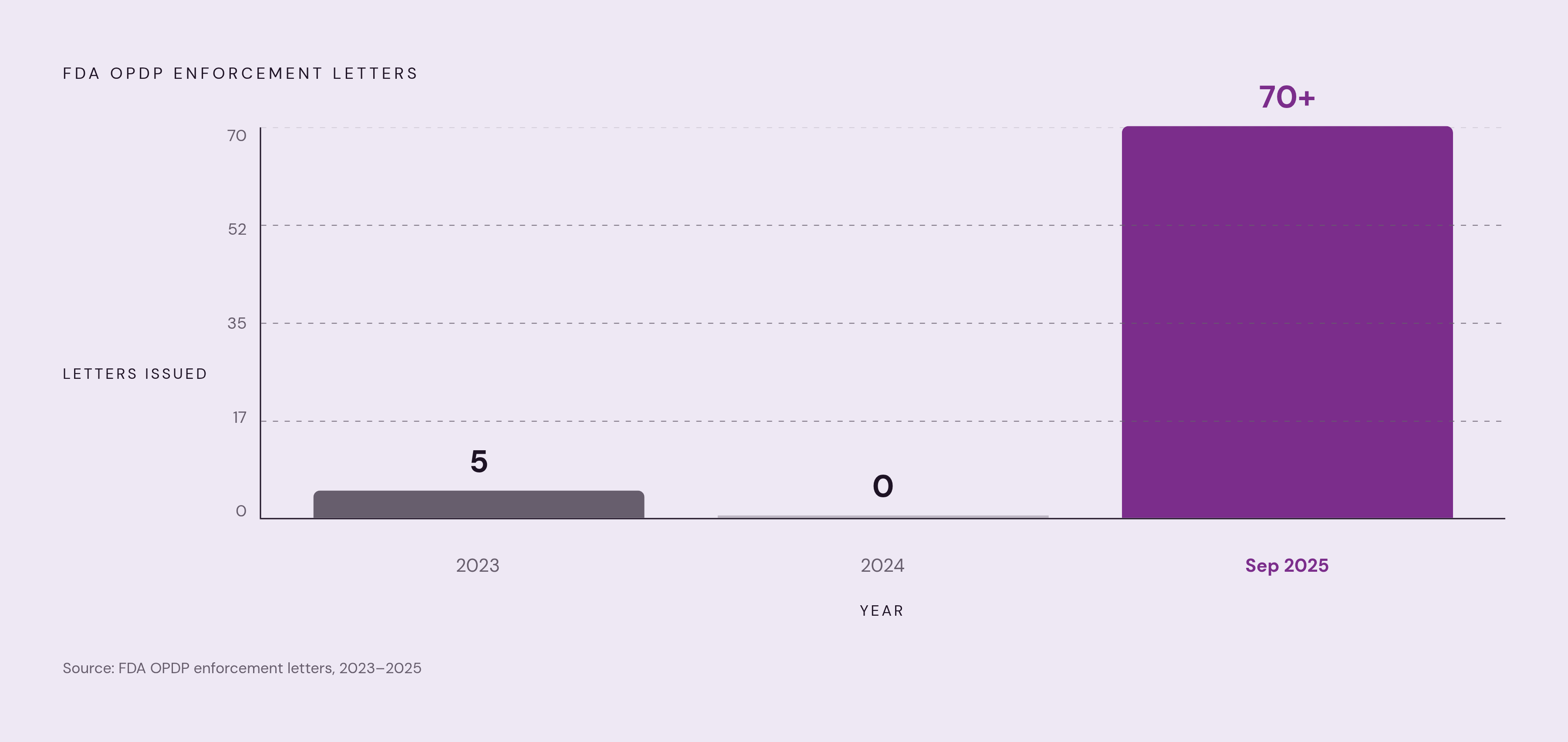
On September 9, 2025, A Presidential Memorandum directed HHS and FDA to increase oversight of direct-to-consumer advertising. FDA moved quickly. That same month, FDA issued over 70 enforcement letters targeting advertising and promotional materials, various promotional materials, including patient testimonials.
That campaign also included additional enforcement actions and got OPDP watching online platforms, something it hadn't done much before.
The reversal looks big only against what happened before it. In all of 2023, OPDP sent out just 5 enforcement letters: a single warning letter plus 4 untitled letters. Pharma companies received just one warning letter in 2023 and none in 2024. Going from no warning letters across an entire year to over 70 in just one month marks a dramatic shift. It's a reversal, and it landed on an industry that had spent two years recalibrating its risk tolerance to a much quieter enforcement environment.
How patient testimonials fail, according to enforcement letters
FDA's enforcement letters offer the clearest picture of testimonials going sideways, laying out how the agency's logic meets real content rather than a hypothetical.
A 2019 enforcement action regarding cholesterol drug testimonials set a precedent for later cases. One patient after another told of moving off their statins over side effects, then having milder or zero side effects on the new drug. OPDP's objection didn't claim the people made things up. OPDP noted that while each testimonial may accurately reflect one patient's experience, they don't back the implication that other people who change to the drug will see the same thing happen. An honest account from one patient turns into a misleading safety claim at the population level without the qualifier that their result doesn't apply to others.
Later letters apply the same reasoning to other product types. On April 28, 2025, Mayne Pharma, LLC received a notice about NEXTSTELLIS. On May 29, 2025, the FDA sent a formal notice to a company marketing ADDYI.
Drugs aren't the only products caught by that logic. Spectra Therapy's LASERwrap product carried testimonials tagged under categories like "Wounds," "Chronic Pain," and "Fibromyalgia," including a claim that the device eliminated pain in seven patients within a week to ten days, after those patients had struggled with neuropathy and plantar fasciitis for anywhere from six months to two years. FDA called it violative. The category shifts. The testimonial reasoning doesn't. One person's story shown as though it predicts what others can expect counts as misleading, whether it's on a drug brand's YouTube page or a product maker's site.
The GLP-1 wave as the defining case study in testimonial-adjacent misleading claims
Through 2025 and into 2026, the FDA enforcement focus fell on GLP-1 drugs like semaglutide plus tirzepatide, while liraglutide was also involved. The category is the clearest example of testimonial-style, patient-facing marketing at full volume once hunger for a drug outruns the stock of authorized, branded inventory. That gap drives almost every breach in this section.
The letters arrived in multiple rounds. September 2025 saw roughly 80 warning letters alongside 40 untitled ones. In early 2026, the FDA issued a series of warning letters to telehealth firms marketing compounded GLP-1 products, flagging claims presenting compounded semaglutide along with tirzepatide as FDA-approved, clinically backed, or on par with branded drugs, which they weren't. In June 2026, the FDA sent 25 warning letters to telehealth companies for misleading claims about compounded semaglutide and tirzepatide on their websites, plus one involving liraglutide.
The same violations show up in warning letters: implying FDA endorsement that isn't there, listing that same ingredient as the branded drug so it suggests interchangeability, and muddying who is actually handling the compounding. FDA applies its misleading net impression standard, and evaluates whether marketing materials, implied comparisons, imagery, and patient-voice content together create something untrue. OPDP has applied that framework for years. The aggressiveness is greater as it's used on telehealth websites and marketing formats that were rare when the framework took shape.
The proposed rule that would reshape how risks must appear in every broadcast ad
A rule sitting in the 2026 Unified Agenda, RIN 0910-AJ14, titled "Transparency in Direct-to-Consumer Advertising," would rewrite 21 CFR 202.1 to eliminate the adequate provision option. It is what has made broadcast DTC advertising commercially workable over about 30 years, and taking it away is no minor change.
If the rule passes, all broadcast prescription drug ads, even patient testimonials, must use the full brief summary: every contraindication and side effect from the cleared labeling, instead of the major statement broadcast relied on under the 1999 guidance. FDA and HHS acknowledge that broadcast DTC spots would likely run longer and incur higher costs under the proposed rule. No one disputes that outcome. Both sides see the same outcome; they just split on the cost-benefit call.
The proposed rule is set to move into rulemaking by December 2026. It's labeled economically important plus a major rule, and FDA acknowledges the rule would impose real costs on a broad set of stakeholders, which tends to mean pushback once feedback opens.
What pharma marketers and their compliance teams should do now
A regulatory scene that swung from quiet to more than 70 letters beginning in September 2025 makes treating any of this as theoretical impossible. Compliance teams holding off for more clarity misread it already.
Legal and Regulatory scrutiny must touch every sponsored, paid, or amplified testimonial, with a checkpoint built in that flags the paid versus unpaid line before content posts, not after a letter lands. ISI placement must satisfy the standard of being clear, conspicuous, and readily accessible wherever a patient promotes an outcome online, whether on a site, social post, or sponsored placement. Each one warrants scrutiny equal to the desktop experience legal saw initially.
Social posts and influencer content require a focused review of the benefit/risk divide. When the positive claims are all there but the risk side is missing, the post falls out of balance, whatever the channel or medium. Period. Teams must learn the net impression standard, since each line in a testimonial can stand on its own yet the full run still comes off as misleading. A prior enforcement action involving cholesterol drugs illustrated this issue, and it's the same issue resurfaced in the GLP-1 letters. Assess the entire initiative as one single claim, not as a series of individually approved statements.