Omnichannel HCP Engagement Strategy for Specialty Drug Brands
A practical framework for reaching specialty HCPs that reps no longer can.
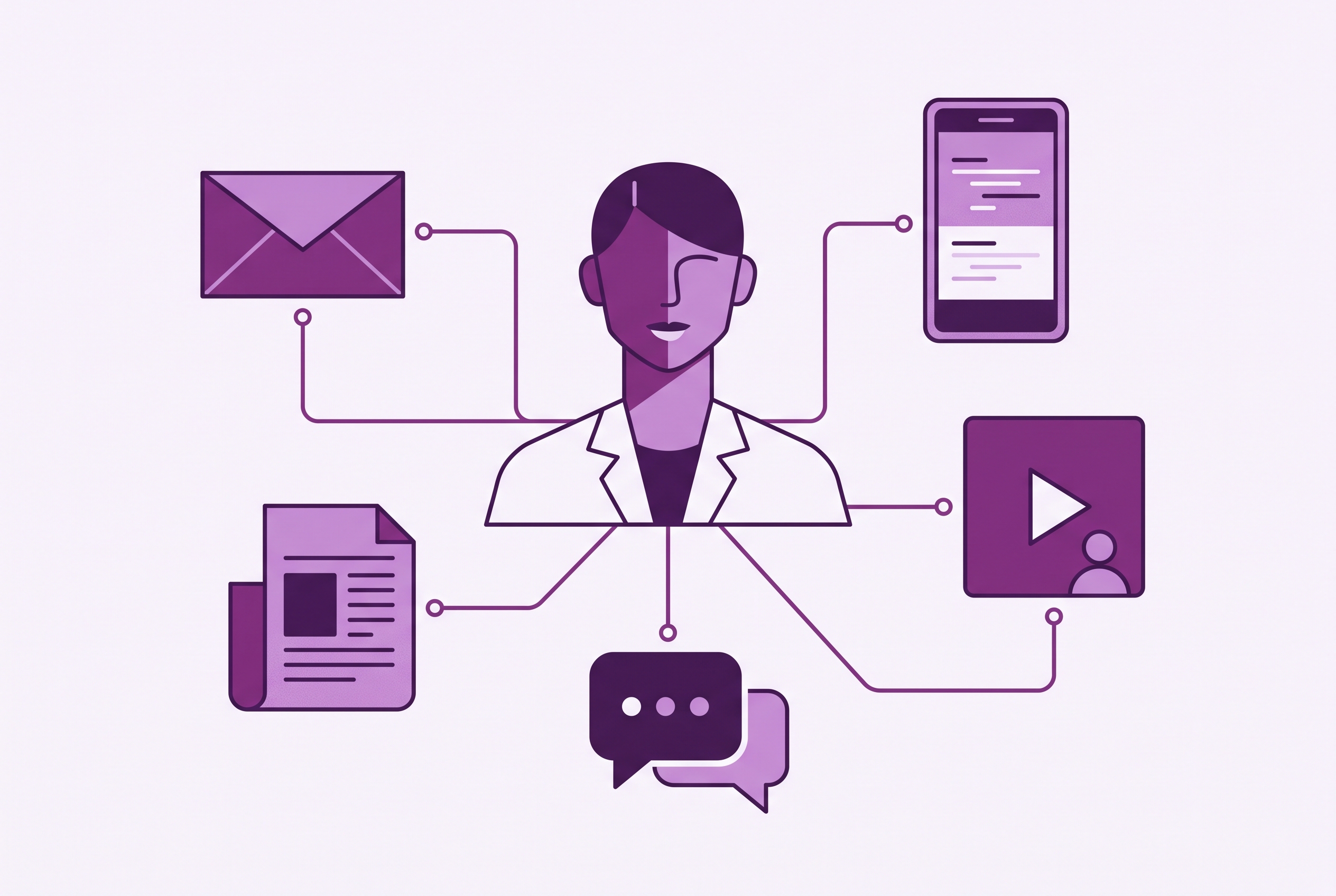
- Veeva Pulse field data: share of U.S. HCPs accessible to field reps fell from 60% to 45% in a single year — not a gradual drift but a step-change
- Half of the HCPs who remain accessible limit engagement to three or fewer companies — scarcity compounds scarcity
- Specialty context: oncology and other specialties where reps can't access important HCPs with a high patient volume — reps literally cannot reach the HCPs who matter most, per Indegene's June 2026 report
- 80% of HCPs still report receiving generic, impersonal communications; fewer than 20% feel personally engaged (Indegene, 2025/2026) — the industry's response to access loss has been volume, not relevance
- 84% of physicians want to maintain or increase online interactions with pharma, per 2025 Viseven analysis cited by Intuition Labs — demand for digital is there; the failure is on the supply side
- Implication: the access problem is not solved by adding more reps or more channels — it requires a fundamentally different operating model; this section's job is to make that case before introducing the framework
What omnichannel actually means in 2026 and where most specialty brands still fall short
- Distinguish multichannel (presence on multiple platforms, brand-centric) from omnichannel (orchestrated, context-aware, customer journey-centric) — use the Dr. Evans scenario from indigitall as the concrete illustration without over-quoting it
- Indegene's June 2026 definition: omnichannel in 2026 means engaging HCPs based on their needs and orchestrating a personalized customer journey where each touchpoint builds on the previous one — not enough to deliver the same message multiple times across different platforms
- Requires omnichannel to function as an operating model, not a campaign layer: connecting data, strategy, content, activation, and measurement into one coordinated system
- The maturity ladder (per Tikamobile/Indegene framing, consistent across sources):
- Stage 1 — Fragmented tactics: isolated email, rep visits, social posts with no integration
- Stage 2 — Multichannel activation: webinars, emails, portals operating in silos
- Stage 3 — Omnichannel orchestration: connected journeys through integrated CRMs
- Stage 4 — AI-driven personalized journeys: behavior-driven, real-time adaptation of content, timing, and channel
- Honest placement: most pharma companies are still at the 'developing' stage per Indegene VP Gurpinder Singh — data silos and legacy systems prevent them from connecting the dots
- For specialty drug brands the gap is more costly: smaller, harder-to-reach prescriber universes mean every misfire is proportionally more damaging than in primary care
- Section should name the ambition-execution gap explicitly — this is the through-line the rest of the article closes
Why data fragmentation is the root cause of poor personalization, not a technology gap
- The fragmentation pattern: marketing holds non-personal promotion data, sales owns CRM records, medical affairs logs congress interactions — no department can see the full HCP picture (Indegene, 2025)
- Even organizations with mature in-house capabilities contend with disparate systems across digital, commercial, and medical teams producing multiple inconsistent views of the same HCP (Indegene, June 2026)
- Data quality compounds fragmentation: inconsistent formats, incomplete records, outdated information skew analysis and produce misguided decisions — "garbage in still means garbage out" (G&CO, 2026)
- The 360-degree HCP profile as the required foundation:
- Must go beyond demographics to include professional interests, prescribing habits, preferred communication channels, and brand interaction history
- A customer data platform (CDP) is the standard architecture recommendation for creating a single source of truth (Indegene, 2025)
- Data governance and regular cleansing are not optional — the "Wild West" scenario where data integrity is compromised creates regulatory and reputational risk
- Specialty-specific implication: with smaller HCP universes, a single mismatched touchpoint based on stale data is proportionally more damaging — wrong channel, wrong timing, wrong message to the one oncologist who drives 40% of your scripts
- Section resolves by establishing that the data foundation must be fixed before channel strategy is layered on top — sets up the next section on what a connected data architecture enables
Building the HCP profile and journey map that specialty orchestration runs on
- The prescriber-level profile as the unit of personalization: advanced analytics must unify patient, provider, and market data to tailor channel, content format, and timing to each individual HCP rather than grouping by specialty (G&CO, 2026)
- Profile dimensions for specialty brands:
- Clinical profile: therapeutic area focus, patient volume, prescribing patterns, guideline alignment
- Engagement profile: preferred channels (digital portal, rep, congress, EHR-adjacent), preferred formats (long-form clinical data vs. microlearning), engagement timing patterns
- Relationship profile: stage in the brand journey (unaware, aware, trialing, committed), last interaction context, open clinical questions
- Behavioral data over CRM labels: real-time signals — time spent on clinical updates, webinar attendance vs. on-demand preference, content format choices — are more predictive than static fields like job title or location (Tikamobile, 2025)
- Journey mapping by lifecycle stage — different stages demand materially different approaches (Indegene):
- Pre-launch and launch: bold, broad strategies emphasizing scientific evidence and care gap identification
- Inline brands: optimized touchpoints and competitive differentiation
- Legacy portfolios: minimize cost-to-serve while maintaining presence
- Practical output: each HCP has a defined current stage, a preferred channel mix, a content format preference, and an identified next engagement moment — this is what next-best-action engines consume
- No specific benchmark here; the section's power is conceptual clarity — the profile and journey map are the architecture, not a campaign
The channel mix that reaches specialty HCPs where they actually engage
- Frame: channel selection should follow the HCP's demonstrated preferences, not the brand's internal production capacity
- The hybrid model as the default: digital touchpoints complement personal interactions, field teams are redesigned around high-value relationship, access, and clinical navigation work AI cannot replicate (G&CO, 2026) — 83% of pharma marketers expected to use combined in-person and digital strategies (Intuition Labs)
- Channel roles in specialty context:
- Rep visit: reserved for high-value clinical dialogue, complex objection handling, access navigation — not message delivery that digital can handle
- Medical science liaison: clinical education for high-scientific-engagement HCPs in oncology, rare disease
- Digital portals and on-demand content hubs: always-on access to clinical data, case studies, treatment guidelines — "pull-first" model respects HCP time (Tikamobile, 2025)
- Email and push: trigger-based, behaviorally timed follow-up — not broadcast blasts
- EHR-adjacent channels: OptimizeRx model — inserting brand messages directly into prescribing software where 68% of physicians prefer to receive information, enabling context-appropriate influence at the point of prescribing (Intuition Labs)
- Webinars and medical education: live for community-building, on-demand microlearning for busy specialists who cannot commit to fixed schedules
- Professional networks and congresses: awareness and peer validation, not primary education delivery
- Hard-to-reach HCPs in specialty: omnichannel can extend coverage to high-volume prescribers reps cannot access — smart channel sequencing substitutes for the rep visit, not just supplements it (Indegene, June 2026)
- The pull-first principle: searchable knowledge hubs, on-demand webinars, self-scheduling tools — HCP accesses on their terms, which generates the behavioral signal the journey engine then uses
How next-best-action engines turn the channel mix into an orchestrated journey
- The defining 2026 shift: from coordinating channels by hand to using AI and next-best-action engines to orchestrate the right message, in the right channel, at the right moment, automatically and within compliance (per Multiplier AI and G&CO, 2026)
- How next-best-action works in practice: if a physician opens a case study on a portal, the system triggers a relevant follow-up on their preferred channel — the action is the signal, the engine determines the response (G&CO, 2026)
- Platform consolidation reflects next-best-action becoming a dominant commercial priority: PharmaForceIQ acquiring Aktana in January 2026 to unify brand and field strategy in an end-to-end commercial customer engagement system (G&CO, 2026)
- Veeva Vault CRM as the leading field-integrated platform:
- As of March 2026, more than 125 customers live on Vault CRM, including two top-20 biopharmas in major markets; 10 top-20 biopharmas committed globally
- Late 2025 launch of Veeva AI Agents: four assistants for Vault CRM (Free Text Agent, Voice Agent, Pre-call Agent (for Vault CRM), plus Quick Check Agent and Content Agent (for PromoMats)) using LLMs from Anthropic and Amazon hosted on Amazon Bedrock
- The human-in-the-loop guardrail: agents propose, humans decide — marketers and medical reviewers remain accountable for final messaging; compliance is an architecture decision, not a review step added at the end
- Performance evidence: Veeva reports a 23% lift in promotional effectiveness from synchronizing sales and marketing; AI-driven HCP engagement platforms commonly report 10% to 30% gains in key metrics (per G&CO); NLP and predictive analytics associated with roughly 30% uplift in campaign relevance (G&CO, Intuition Labs)
- Agentic AI caveat the writer must carry: McKinsey estimates 75–85% of pharma workflows contain tasks agents could automate, potentially freeing 25–40% of capacity; but Gartner estimated in June 2025 that of thousands of vendors claiming agentic capability, only about 130 were genuinely agentic, and predicts more than 40% of agentic AI projects will be canceled by end of 2027 citing cost, unclear value, and inadequate risk controls — specialty brands should evaluate vendor claims carefully
Where AI-generated answers are reshaping how HCPs find drug and clinical information
- The scale of the shift: 54% of HCPs now use generative AI in clinical contexts — querying drug information, summarizing trial data, checking guideline alignment (IQVIA, March 2026); OpenEvidence, one specialist clinical AI platform, reported 18 million monthly queries from verified physicians
- Varn Health survey (126 verified HCPs, 2026): over half currently use AI-powered search in some form in their role; a further 18% plan to start using it soon — adoption is driven from younger practitioners upward, per Varn Health CEO Tom Vaughton
- The search surface has changed: Gartner notes traditional search engine volume has dropped 25%, with organic traffic falling further as generative AI becomes the default research interface; BrightEdge tracking shows Google expanding AI Overview presence in healthcare from 59% of keywords in December 2023 to 89% by December 2025 — the highest of any industry BrightEdge measures; clinical content (treatment, procedure, symptom queries) now at 93–100% coverage
- What this means for specialty brands: an HCP querying a generative engine about a therapy area or specific drug will receive a synthesized answer — the brand may or may not appear in that answer, regardless of how well-optimized its traditional digital presence is
- The Everything-PR Healthcare Citation Share Index (June 2026, 75+ queries across ChatGPT, Claude, Perplexity, Gemini, Google AI Overviews): top 15 brands capture roughly 64% of all category citation share — AI citation is already concentrated, and the gap between visible and invisible brands is widening
- Section ends on the implication, not the solution — the solution comes next: specialty brands need a deliberate strategy for AI answer surfaces, not just web SEO
What generative engine optimization means for specialty drug brands and how to act on it
- Define the terms precisely so the writer can use them accurately:
- GEO (Generative Engine Optimization): measuring and improving how generative AI engines cite, rank, and describe a brand inside the answer they generate — across ChatGPT, Claude, Gemini, Perplexity, Mistral, Grok, Copilot, DeepSeek; unit of success is the citation (frequency, position, sentiment, sourcing)
- AEO (Answer Engine Optimization): narrower discipline focused on direct AI answer surfaces — Google AI Overviews, Bing Copilot, ChatGPT direct answers, Perplexity quick answers
- SEO remains relevant but is no longer sufficient when 48.7% of healthcare-related page-one Google queries trigger AI Overviews before any organic links (Conductor, 2026)
- The Healthcare Monitor Pharmaceuticals 2025-2026 (Worldcom Public Relations Group), one of the first systematic GEO analyses across ten major pharma companies (AbbVie, AstraZeneca, Bristol Myers Squibb, GSK, Johnson & Johnson, Merck & Co., Novartis, Pfizer, Roche, Sanofi
Sources
- Pharmaceutical Omnichannel Marketing Trends & Strategy 2026 | G&CO.
Supplied the hybrid-model framing, next-best-action example, data-quality warning and performance ranges.
- Pharma 2025 Guide: Omnichannel & AI Strategies for HCP Digital Engagement
Provided the maturity ladder, behavioral-signal emphasis and pull-first content model.
- Omnichannel Marketing in Pharma: The Ultimate Guide to HCP & Patient Engagement - indigitall
Provided the Dr. Evans scenario illustrating multichannel versus omnichannel.
- Omnichannel Strategies Pharma Needs in 2025
Supplied the data-fragmentation pattern, CDP recommendation and lifecycle-stage journey guidance.
- Beyond the Buzzword: What It Actually Takes to Execute Omnichannel in Pharma
Contributed the omnichannel definition, hard-to-reach HCP access problem and disparate-systems point.
- Pharma Omnichannel Marketing in 2026: Trends, AI & HCP Engagement
Supported the 2026 shift toward AI-orchestrated next-best-action journeys.
- Managing and Tracking HCP Engagement in Modern U.S. Pharma Marketing | IntuitionLabs
Supplied the 84% online-interaction figure, 83% hybrid strategy figure and the EHR-adjacent channel statistic.
- https://www.tellius.com/resources/blog/ai-agents-for-pharma-commercial-teams-the-2026-field-guide-to-use-cases-vendors-and-whats-actually-real
Matches the agentic AI caveat covering McKinsey workflow estimates and Gartner vendor and cancellation predictions.