Medicaid Managed Care Plan Engagement Strategy for Drug Brands
Drug brands must navigate three hidden layers—MCO, PBM, and formulary—to reach Medicaid patients.

Medicaid no longer runs the way it once did, so any drug maker still relying on an outdated access strategy is working from a plan designed for a system that has since disappeared. Instead of the old pay-separately model, risk-based managed care now operates the program in nearly every state, plus the District of Columbia and Puerto Rico. Any brand that treats the old pay-per-service setup as a parallel route deserving equal funding alongside managed care has misread how the program is put together today. MCOs now sit in the middle of nearly all beneficiary interactions with the state, so working with them is essential to any brand that hopes to reach Medicaid patients.
The population covered by that system is shrinking and shifting too, and that makes waiting riskier for brands. A federal legislative package includes provisions expected to push further declines in sign-ups among these groups from 2026 through 2034. A brand delays building its access strategy at the price of fighting over fewer covered lives later. Those losing coverage are not spread evenly through the risk pool. States have seen enrollment and spending climb since the unwinding of continuous coverage, with several noting that beneficiaries who kept their coverage tend to carry more complex medical requirements than people who fell off the rolls. As Medicaid enrollment concentrates more heavily in high-acuity and long-term conditions, winning preferred placement on the drug list in these categories becomes more valuable while losing it becomes more expensive.
The MCO, PBM, and PDL as Three Interdependent Decision Layers
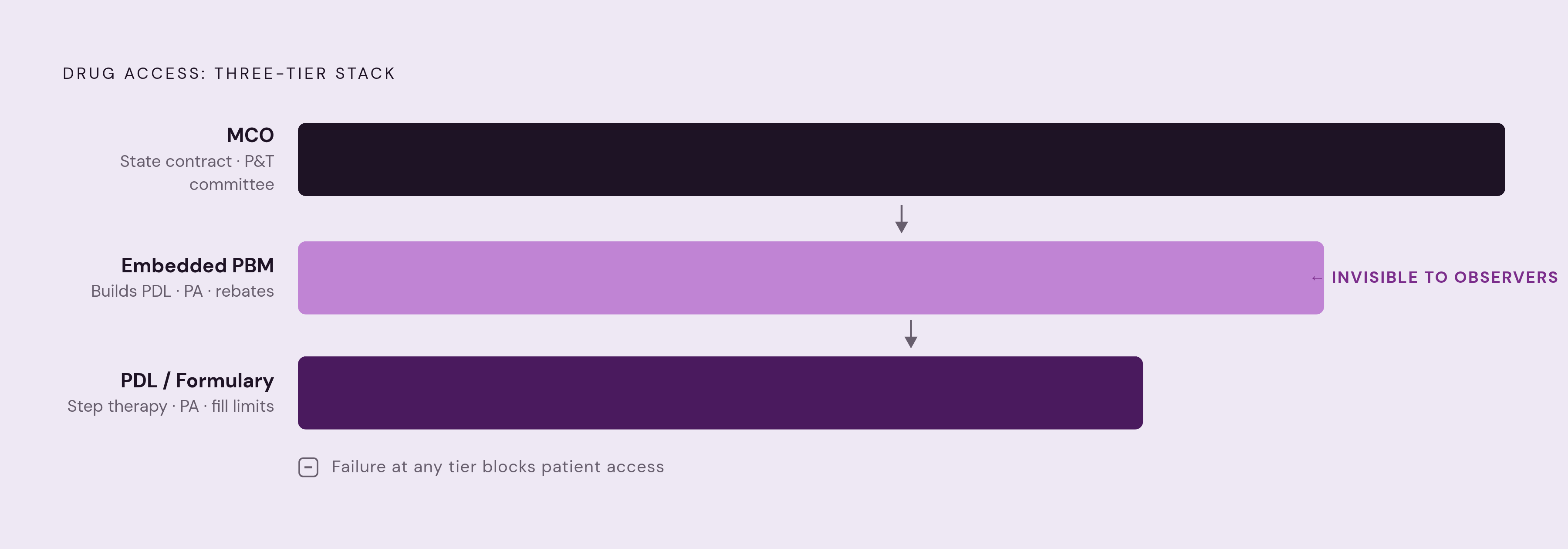
Contact with the MCO starts a three-part setup, not the whole job. A brand may know the MCO well, but until it identifies the pharmacy benefit manager inside the arrangement and the formulary rules that sit behind it, it has dealt only with the outer tier of a stack where two additional tiers can still keep that patient from receiving that drug.
Start with the relationship to the MCO. The state agreement sits with the MCO, which also defines plan strategy and directs the committee handling Pharmacy and Therapeutics review for formulary choices. At this level, the product narrative, outcomes data, and account-level relationships matter, with access teams typically already comfortable engaging this layer.
An embedded PBM forms a second layer that remains largely invisible to external observers. As noted in a May 2026 MACPAC issue brief, Medicaid managed care organizations typically engage pharmacy benefit managers to administer prescription drug programs. These managers build the PDL, run prior authorization, adjudicate claims, and secure rebates on behalf of the plan. As a result, the organization truly directing everyday drug access is seldom the MCO where brand representatives have been holding discussions. Without identifying the specific PBM operating within every target MCO, a brand leaves an access gap that relationship efforts directed at the plan alone cannot bridge. MACPAC points out that typical PBM offerings like utilization oversight, drug utilization assessment, and claims handling serve as potential bottlenecks capable of delaying or blocking a brand's drug regardless of prior MCO discussions. State oversight of this layer has grown in recent years, with HMA's 2024 national survey reporting that over half of states carving pharmacy benefits into MCO contracts required PBM transparency reporting by July 2023, while most MCO states now ban spread pricing in these arrangements. With this layer now drawing greater scrutiny and tighter regulation, brands gain fresh openings for engagement that were unavailable only a few years back.
As the third layer, the PDL (or formulary) converts those initial two tiers into tangible coverage results for an individual patient. According to MACPAC, this formulary steers prescribing toward favored products by imposing lighter utilization management hurdles on them compared with therapeutically similar but non-preferred alternatives. Within Medicaid managed care, getting preferred placement is how access actually works on the ground. Because securing a spot typically hinges on manufacturer rebate agreements, the PDL functions essentially as a business arrangement carrying clinical weight.
Each layer builds upon the previous one in a cascading chain. The MCO establishes the strategic direction, which the PBM executes by constructing and overseeing the PDL, while the PDL ultimately shapes the specific utilization management hurdles that determine what clinicians and patients encounter when filling prescriptions. A shortfall in any single tier negates the progress achieved across the remaining two. Securing MCO approval while overlooking the PBM component, or gaining PDL placement without resolving UM criteria, leads to identical outcomes: patients remain unable to obtain their medication.
Carve-In vs. Carve-Out: Which Layers a Brand Must Engage, and in What Order
A brand should begin state planning by clarifying the benefit design: are pharmacy benefits folded into this state’s MCO arrangements or handled outside them? It determines who holds PDL authority, which supplemental rebate route is in play, and therefore the key variable for ordering the brand’s engagement.
Across the country, carving pharmacy benefits into managed care remains the prevailing approach. HMA's 2024 survey showed that in most states, MCO contracts still include pharmacy benefits, meaning brands must prepare to navigate the entire MCO-PBM-PDL structure outlined earlier on a state-by-state basis. Where pharmacy benefits are carved into managed care, direct control over formulary decisions rests with the MCO and the PBM embedded within it. Where carve-out applies, authority shifts to the fee-for-service PDL, with supplemental rebates moving through an alternative channel. Before deploying account resources, a manufacturer must verify which model governs each state, since a mistaken assumption leads teams to bargain with the wrong counterpart.
Michigan shows an important variation within this approach. Through Michigan’s Department of Health and Human Services, the state moved Medicaid managed care onto a single formulary, making what might have been separate plan talks one decisive statewide call. A manufacturer that targets Michigan’s MCOs while bypassing P&T review by the state risks being shut out statewide by a single higher-level call.
Even in a carve-in state, not every drug follows the same rules. As HMA observes, numerous states with MCO arrangements exclude specific medications or therapeutic classes from those agreements to mitigate financial exposure for costly treatments and for additional purposes. Brands in complex therapeutic areas like oncology, cell and gene therapy, or other specialty categories should confirm whether such exclusions apply before treating MCO engagement as their primary lever. A few states go further and mandate that every participating MCO rely on a single PBM selected at the state level. That setup removes the work of tracking down each plan's own PBM, but it moves the real relationship target from individual plan PBMs to one PBM at the state level, so a brand's outreach has to match that shift instead of falling back on the strategy used elsewhere.
Supplemental Rebates as the Primary Commercial Lever Across All Three Layers
Supplemental rebates translate access plans into formulary decisions, with their operation shaped by whether the state or the MCO manages the pharmacy benefit in that market. In HMA's 2024 survey, almost every state plus the District of Columbia reported active supplemental rebate agreements, confirming that Medicaid managed care treats them as routine practice rather than a specialized tactic for select markets.
Brands should weigh a structural advantage these deals carry: the supplemental rebates struck between Medicaid managed care organizations and drugmakers fall outside the federal government's usual Medicaid rebate reporting. Rivals therefore cannot see what any single arrangement involves, which turns the rebate into a private, strategically useful tool instead of a publicly disclosed price point. How the plans across the table are faring financially also matters. According to HMA's analysis, about half of MCOs ran negative underwriting margins for calendar year 2025, and plans under that sort of strain tend to police drug spending harder. In that environment, a brand pitching a rebate must be able to make a convincing case for its value, because a price concession on its own, without outcomes data behind it, carries less weight with a financially strained plan than an otherwise identical offer backed by evidence.
Two federal models are resetting the ground on which this kind of negotiation now takes place. KFF lays out the GENEROUS Model (GENErating cost Reductions fOr US Medicaid) in its May 2026 brief, launched in January 2026: CMS negotiates supplemental drug rebates pegged to most-favored-nation pricing overseas and channels those savings to units under both Medicaid fee-for-service and managed care. Participation is optional on the part of states and manufacturers alike, yet for a brand considering whether to join, the model redoes the rebate baseline for the whole portfolio, not just one state or plan. KFF's brief next turns to the BALANCE Model (Better Approaches to Lifestyle and Nutrition for Comprehensive hEalth), which takes that same approach but narrows it to one therapeutic area: BALANCE, set to launch as early as May 2026, would work by bargaining down GLP-1 prices via supplemental rebates in return for broader Medicaid and Medicare coverage. BALANCE establishes a model for managed access arrangements that link price to expanded coverage, and this framework applies to any brand operating in a costly therapeutic area, regardless of whether GLP-1s represent the category at hand. No single approach offers a clear answer for every brand. The value of joining hinges on each company's unique portfolio mix, geographic reach, and competitive landscape, with the assessment varying from one organization to the next.
Where the rebate mechanism is going, though, is not up for debate. KFF points out that rebates take out more than half of what Medicaid would otherwise spend on prescription drugs, with state supplemental rebates now accounting for a bigger piece of every rebate paid. This tool is becoming increasingly central to Medicaid's approach for controlling pharmaceutical costs. Brands must therefore build their commercial plans around rebate talks as a permanent, expanding element of gaining formulary placement instead of an expense destined to shrink.
The PDL's Prior Authorization and UM Criteria as the Final Access Gate
Being listed on the PDL still leaves a patient short of the drug. Access is really decided by those controls, including first-approval rules, step requirements, and fill limits, so prescribers and patients meet the true barrier there, while many brand engagement plans leave usable options untapped.
According to MACPAC, a medication’s position on the PDL dictates the prescriber’s administrative and clinical workload, since favored options encounter less UM scrutiny compared with their non-preferred therapeutic counterparts. Where a drug lands on the formulary shapes patient access during the clinical encounter rather than just reflecting negotiations finalized long before. Research clearly quantifies the patient harm that results from such missteps. The American Journal of Medicine published a systematic review showing that waiting for prior authorization worsened disease, led to avoidable hospital admissions, extended inpatient stays, and reduced disease-free survival rates in several fields, cardiology and oncology among them. Manufacturers can therefore present this evidence to MCO medical directors and P&T committees to justify reducing excessive UM requirements for specific therapies.
Even so, a drug's PDL status, fixed at the state level, is not the whole picture. Beyond the state PDL's baseline, PBMs and MCOs layer on their own utilization-management rules, among them clinical edits, authorization requirements, and spending caps, and plan-level UM stacked above state rules is well documented. It builds brand-specific barriers that winning at the state PDL cannot fix by itself.
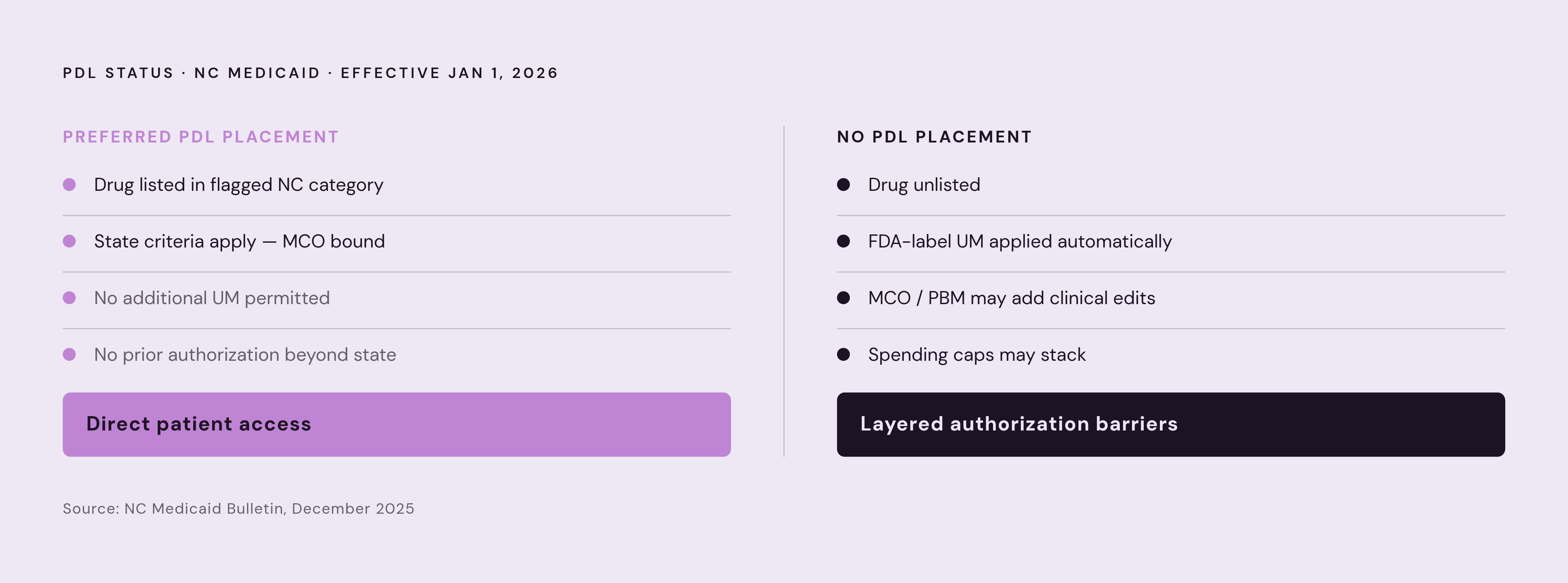
North Carolina demonstrates how removing that discretion works when a state actually does it. NC Medicaid's December 2025 bulletin announces that, starting January 1, 2026, red text will mark the drug categories on the state's PDL where Managed Care plans cannot impose UM or prior authorization requirements that go further than state criteria. In those flagged categories, securing a preferred spot on North Carolina's PDL strips the MCO of any power to add further hurdles, which is precisely the goal brands should pursue wherever states adopt comparable carve-in structures. NC Medicaid adds that a drug absent from the PDL may face FDA-label-based UM solely where the state has published no clinical criteria of its own and has not barred such criteria for that product or therapeutic group. The contrast is stark: brands without PDL placement automatically face FDA-label-based UM, whereas preferred brands in the designated categories face none.
Pending federal regulation offers lever brands an unprecedented window on how often requests get rejected. The CMS 2026 proposal on Interoperability Standards alongside Prior Authorization for Drugs mandates that state Medicaid managed care organizations furnish providers with a clear explanation whenever they turn down a drug prior authorization request, effective October 1, 2027. Once the mandate goes live, publicly available rejection statistics will finally let manufacturers approach P&T committees and plan medical directors with hard facts rather than stories. Paired alongside evidence showing how UM criteria slow treatment, this openness equips manufacturers to argue for the North Carolina model: preferred tiers that guarantee real access instead of merely shifting paperwork into a prior authorization step.
Sources
- May 2026 Advising Congress on Medicaid and CHIP Policy
- Utilization Management by Managed Care Plans Aligned with Food and Drug Administration Labeling
- 1 WWW.HEALTHMANAGEMENT.COM State Approaches to Managing the Medicaid
- Recent Trends in Medicaid Outpatient Prescription Drugs and Spending
- Medicaid Health Plan Common Formulary
- Medicaid Enrollment & Spending Growth: FY 2025 & 2026
- Medicaid Managed Care Enrollment Declines in Q1 2026: HMA Analysis of State Trends and Market Share
- Federal Register :: Medicare and Medicaid Programs; Patient Protection and Affordable Care Act; Interoperability Standards and Prior Authorization for Drugs for Medicare Advantage Organizations, Medicaid Managed Care Plans, State Medicaid Agencies, Children's Health Insurance Program (CHIP) Agencies and CHIP Managed Care Entities, and Issuers of Qualified Health Plans on the Federally-Facilitated Exchanges